
Stunning Silk Eco Printing


Oh my gosh, I have never really known how amazing silk is. ‘And even better than that is how easy it takes Eco Printing. How wonderful can it be when all you need is nature to make permanent impressions for you. Make yourself a Stunning Eco Printing scarf or give as a very unique gift.
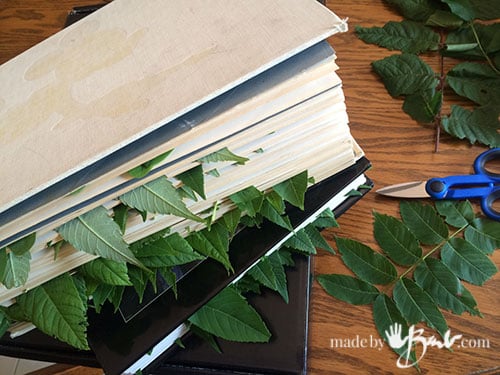
I have collected a lot of leaves to get me through the winter (sounding like a squirrel). Placed in old books or in stacks of newspaper they store well. Just make sure to not apply too much pressure as then they will turn black. Check on them as they dry. For some basics of Eco Printing check my post here
Step #1: Preparing the silk fabric
Silk is known as a protein fibre since it made by animals; silk worm. Protein fibres are easier to take dye and printing so they perform quite well with just a dip (at least 30 minutes) in vinegar water (about a 1 : 3 ratio water to vinegar). I have found that silk is expensive and finding fabric to make scarves is a challenge. You can buy finished scarves here. They work quite well and save time on hemming etc.
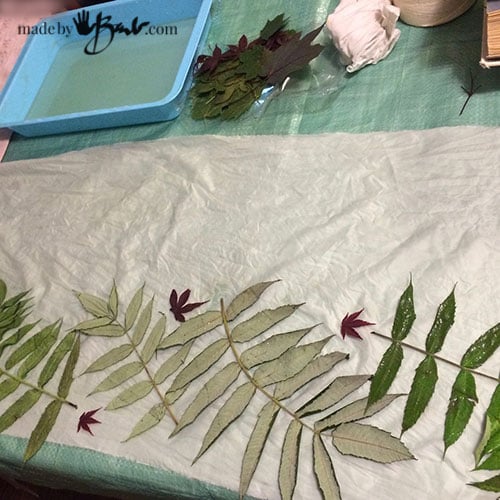
Step #2: The Layout
After wringing out the vinegar water, lay the silk out smooth and flat. Silk is quite strong even though it has always seemed like a fancy fabric.
As a choice of leaves I tend to use my regulars. I like sumac, maple, japanese maple, rose, walnut, and eucalyptus. But don’t feel limited to that. Depending where you are, you may have other choices that I don’t.
As seen in the cotton printing the leaves are dipped in ‘iron water’ (a solution of water and rusty items) to make the prints permanent. I have learnt that too strong of a solution will print very black. So with the silk I use a very diluted ‘iron water’. When in doubt, do a test.
My theory; I go light so that if it prints too light I can always do another printing.
As you see in the picture the scarf is quite wide. It is too wide to fit in my steaming pot so I plan to fold it in half. Place the leaves up to the midpoint and then fold the other half over. This will allow the leaves to print both sides.

Step #3: The Barrier Layer
Since the silk is so thin, I did not want any bleed through to other layers. Plastic paint drop clothes can be easily cut to the width of strip that you require. (keep folded, cut and then unfold)
Place the Barrier layer over the top of the folded silk.
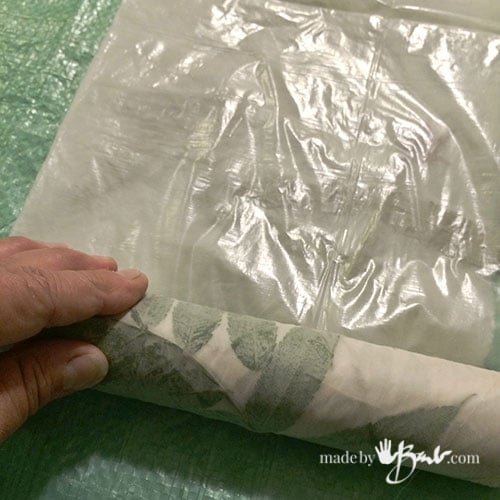
Step #4: Roll it up
Very carefully flatten and smooth the layers as you roll tightly around the centre dowel or pipe. Silk smooths nicely to provide the best prints.

Tie it up tightly and evenly. The best ‘clean’ prints happen when the leaves are well contacted to the fabric. I usually let the plastic wrap around the outside as well.

This is a natural technique but it does use energy to steam or boil the rolls. So I make sure I do a few together to make it worthwhile.
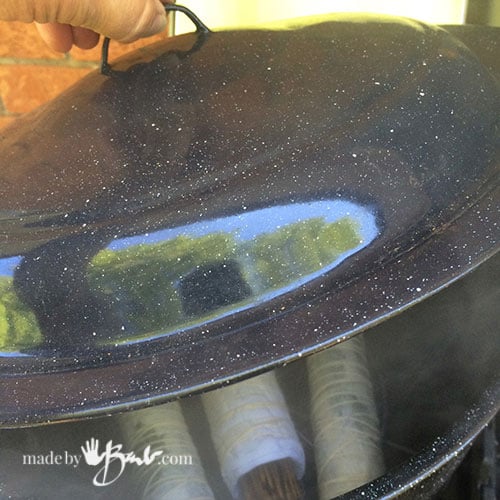
The leaves will emit some odours that may be somewhat disturbing to some, so I steam them outside or under a good vent fan. Put enough water in the bottom of the pot to keep it from running out. Use the canning insert or other steamer basket to keep the rolls elevated. Turning the rolls often will help distribute the heat and allow even printing.
I usually steam for about 2 hours. As an extra way of letting more printing happen I often leave them in a bag to cool down. In the summer they can heat up in a garbage bag in the sun.
Step #5: Check out the Magic!
Cut the string and unwind. Try to contain your excitement as it’s feeling like ‘Christmas morning’! This the part that makes Eco Printing all worthwhile and so much fun.
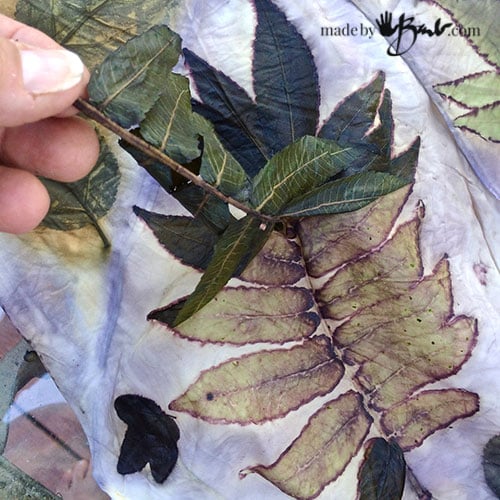
Peel off the leaves and be amazed at how they provided colour and detail.

Notice how the top and bottom printed differently. Take notes so that you can start to predict what you will get.
The Japanese maple has printed with reds; so lovely

The silk scarf will be lovely as it is a somewhat symmetrical design. Let it dry or wash and rinse right away. I use a ph neutral detergent (Dawn) and wash by hand.
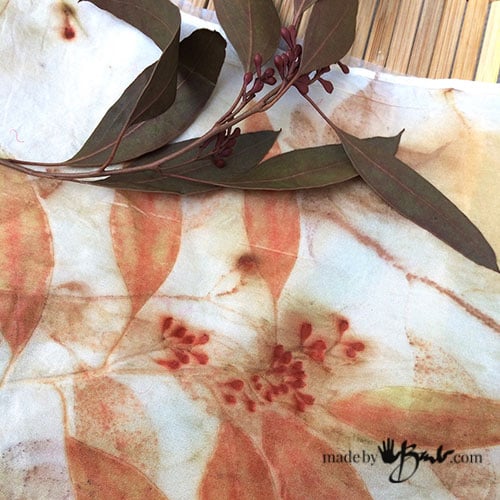
Eucalyptus has been known as quite a colourful printer, however it also depends on the specific species. In canada it is harder to acquire so I stay with local (free) leaves.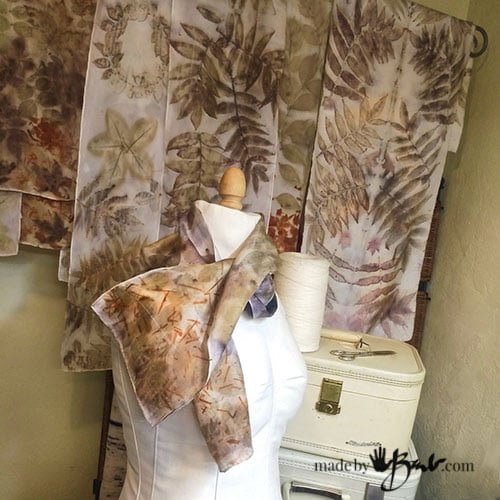
Step #6: Make Many
With Silk Eco printing before you now it you will be making another… and another… and ordering more scarves or looking at the labels of your clothes to see if you can dye it.
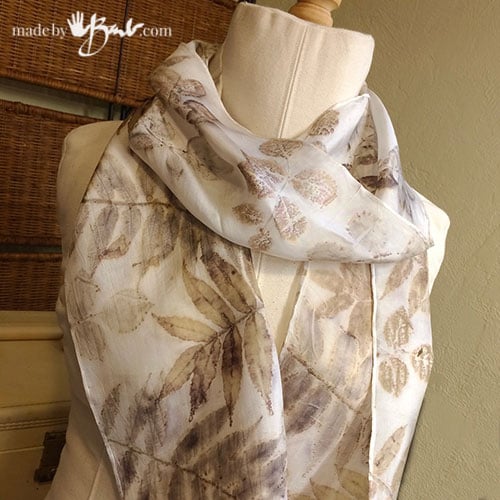
After a gentle ironing it looks so exquisite. Soft neutral and earthy tones depending on your choice of leaves. Won’t these make some OOAK (One of a Kind) gifts?!
This is by no means the limit though. This is still the start as the next stage is to add stronger colour with natural dyes. Stay tuned…
Have you tried this with flowers too? I think this is so cool.
It would seem that flowers give even better prints, but that does not usually happen. There are a few that I’ve seen print but I stick to my predictable leaves. Flowers are usually too delicate to take the steaming and the colours fade or can’t take the heat. But don’t get discouraged, there stronger colours in more posts.
Must you dry the leaves before use?
How did you achieve a dark ground around the printed pattern?
No, you don’t have to dry them. Sometimes I do collect for later though. That dark is probably from the reaction of the iron water and the tannin in the leaves. Each specie is different. Doing tests is key!
Pls what is iron water, and can one use any plant?
Iron water is a rusty solution made with rusted items or from iron sulphate powder. Not every plant will have tannins to react with the iron. There are many ways to eco print. Do check out many of the posts: https://www.madebybarb.com/category/at-home/eco-printing/ I tried many variations, fabrics and plants. It’s a fun process…
Along the flowers line….I am thinking about high pigment items, such as: sunflower petals, echinacea petals, marigolds, nasturtiums. I think I might do some experimenting next summer, and let folks know what happens.
Yes, that’s about the only way to get a sense as so many factors play into it. I have in my research seen some of those print but because of the shapes and contact it is not always obvious that it was a flower. I like the clear prints that actually look representational so I stick to my faithful ones. I would be interested to see how it goes…
I’ve used cosmos and the color was a beautiful bright red – the cosmos were orange, so it was a nice surprise. I’ll also used golden rod and got the yellow. I was printing on watercolor paper both times.
Yes, I love paper printing too! We have finally have a good abundance of green here now, so I better get steaming! I need to get some flowers too!
Love the information on Eco printing! Your scarves are beautiful. I have just started to do some myself and yes, it is addicting! I appreciate you sharing your craft and can’t wait to see more posts on the use of natural dyes.
Oh thanks! I just had to list some of the scarves on my Etsy Store since the line I had hanging across my studio was chock full. It’s always great to have a place to be able to see them constantly and compare (and admire the hard work) I have to stop my self from making some every day.
Barb.., you are an amazing artist. I’m in awe of your beautiful handiwork. I’m 68 in a few days and caring for my dying Mom, in my sisters home. Once I am in my own home, I am going to give this a try. In the meantime, I’ll send all my friends to Etsy to buy a scarf. And me too. Love it.
Thanks so much! I will be listing a lot of new scarves soon! Stay tuned!
Would you please provide a little more detail on how to make the iron solution.
I have a large bucket that I soak some railroad spikes in. The water turns a rusty colour and smells like iron. I do not really know the strength other than with experimentation. If you want exact recipe you may need to take a course or research some more. Many artisans have needed to do much testing to get results and are not too happy to just give out recipes.I know it’s taken me many months and many pieces until I have some expectable results.
thanks alot for sharing, love from indonesia!!
where i can the theory book, ?
I am not sure what you are referring to…?
I met a woman who was doing that with silk ties. She would buy silk ties at thrift stores, take them apart,, discard the lining and wrap them in the white silk scarves similar to what you do and process them. The scarf I saw was unique in color and pattern. Just a thought.
Yes, I’ve seen that done with eggs too. Could be great but you are at the ‘mercy’ of the silk ties. Leaves are pretty well free and oh-so unique! See some of the scarves here
Does this only work on silk? Or do other materials work too?
It will work on natural fibres and also nylon. Check here for an over-view
Maravilhoso!!! Parabéns e obrigado por compartilhar!
Muito Obrigado!
Really nice to see your work .It’s amazing.I am also an artist.I usually paint silk dresses and cotton dresses.Now a days I am painting silk scarves.Can we do this on cotton fabric.
Yes, eco printing has many medias that can be used. Cotton is a cellulose fabric and does print with different mordants. Many options. See here about using cotton.
They are BEAUTIFUL!
Thanks for sharing!
Thank you! The unpredictability makes for so much fun and anticipation! I have to stop myself from rolling up bundles every day! Next; paper tests!