
DIY Ultimate Fitted Face Mask

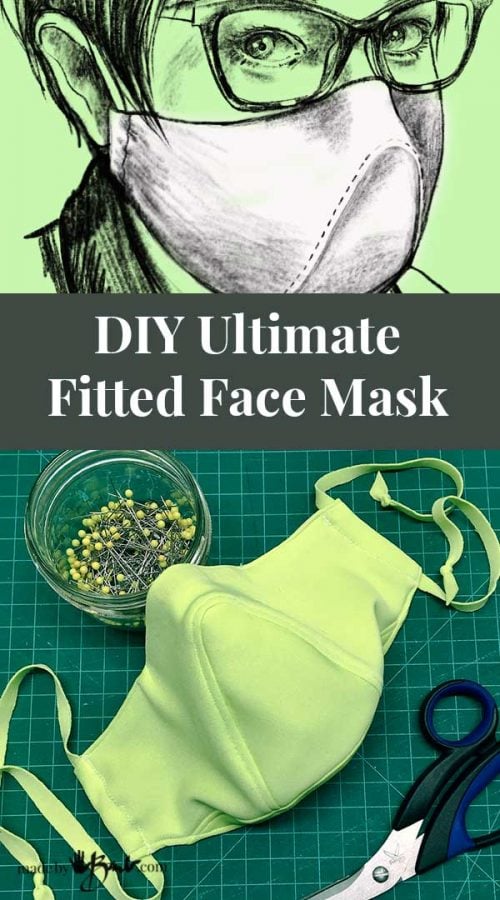
I love to design, and this pandemic has given me a new reason! You won’t believe how I make a pattern of a face. Here’s a new Ultimate DIY Fitted Face Mask & Pattern and how it came to be.
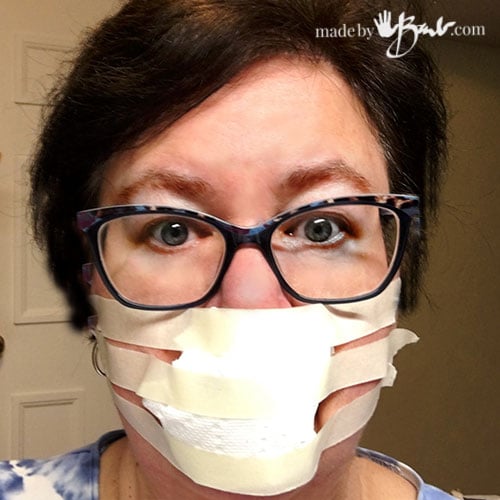
Funny face:
I hear you laughing… I was trying to laugh too. Yes, when you want to create a pattern from a 3D form what do you do?! I could not put my face in silicone soooo, tape is the next best thing. To create the ‘space’ that I wanted inside the mask I created (taped) a bunch of paper towel in from of my mouth and nose.

Next step is to cover my face with tape as close to the shape as possible. I know you are wondering if I could breathe – yes a little. But it’s all for the sake of making people a bit safer with a good mask so it was worth it! The masking tape underneath would allow this to come off a bit easier. Who needs facial waxing?! This pattern is great (thousands have downloaded) but our face does not have a centre seam. ‘And I love the challenge of forming a pattern. I have done that most of my life but never for a face! How unique the facial form is…

I have made forms of bodies and feet this way but never a face. I know it’s ‘my’ face but I think I’m pretty average… ok I have some cheeks!

Before the digital age I had taught 3D design (when the dinosaurs still roamed the earth) and we would deconstruct shapes to flatten into fold up paper structures so this is much the same since fabric is as flat as paper.
It needs to be symmetrical and looking for the flattest planes helps to where to cut it into pieces.
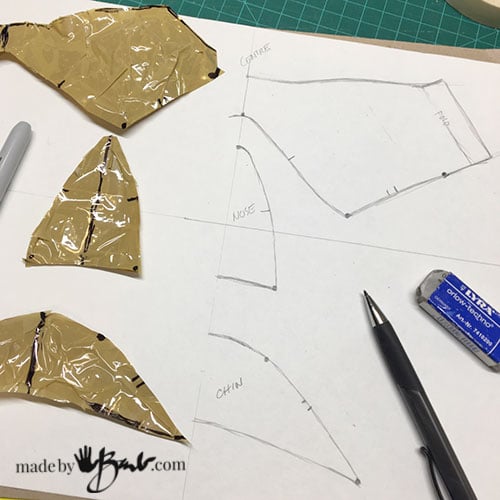
Marking where pieces attach & line up is the same as the notches in sewing patterns.

From these pattern pieces I added 1/4″ seam allowance to the DIY Fitted Face Mask Pattern.
The Pattern:
You can download the pattern here

Cut the Pieces for the DIY Fitted Face Mask:
Once you have printed the pattern (100%), cut the pieces as marked. This pattern makes an inside layer and outside layer; pretty identical shape but the sides are open to allow easy turning and also to make a filter pocket if you want to insert filters.
**UPDATE: I have updated the pattern file as there may have been a layer that obstructed the view if printing. Feel free to download the fixed one.
Step 1:
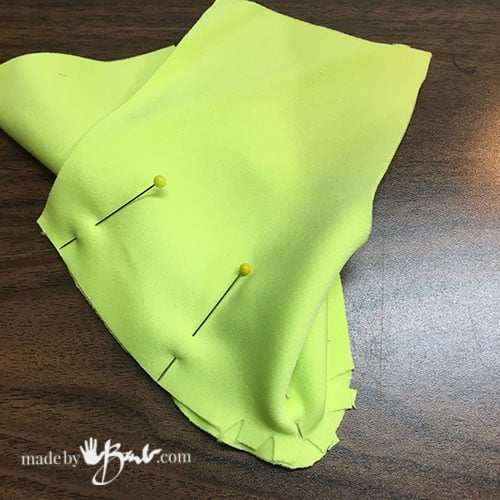
The hardest part of this design is the top of front nose piece. To make it easy clip the top inside (as marked on pattern) curve so that it can stretch around the top curve of the nose piece. Matching notches, sew with the large face piece on top so that you can see as you slowly sew around the curve.
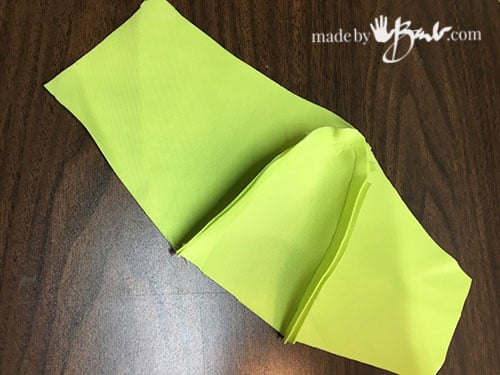
Step 2:
After opening up the front (press if desired) I topstitch it towards the outside. It will keep it’s shape much better and therefore not always be touching your lips and nose.
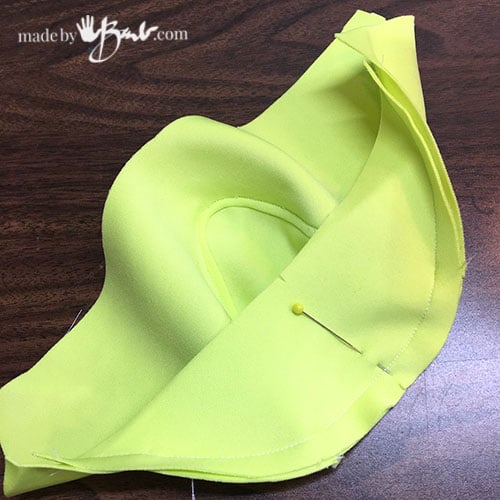
Step 3:
The rest to make this fitted face mask is quite easy. The chin piece gets attached to the bottom matching notches and centre. You can do a bit of a ‘fit test’ to see if you need adjustments.
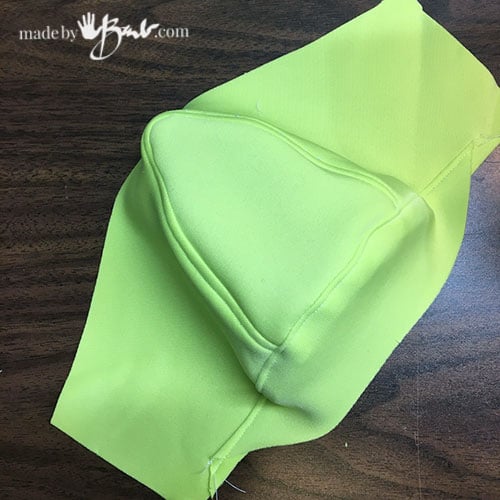
Step 4:
Again to keep the shape I topstitch towards the bottom. This is a polyester knit so it keeps it’s shape well. I know many suggest cotton however I wonder about the way it absorbs moisture and keeps it. Why is all workout wear not cotton? I suggest that you make your own choices of fabrics and also filter products as there is so much conflict for each material.

Step 5:
Repeat all the same with the lining fabric. In this fitted face mask I used a cotton.

Step 6:
Fold the lining ends inward (edges can be finished if desired) and only sew top edge
The there is a nose wire/metal band ironed next to the seam as I did with the Snug-nose Bridge Mask.
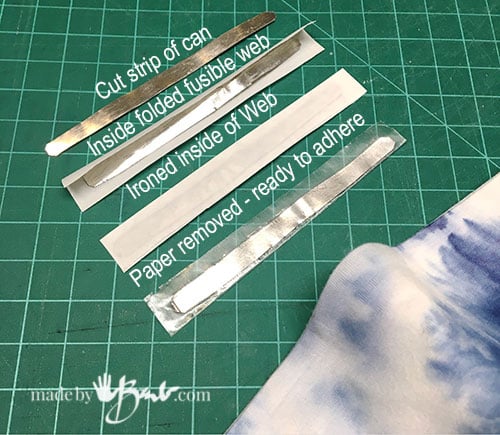
Fusible webbing and some strips cut from cans like sardine (top flap) or tomato work great.

Step 7:
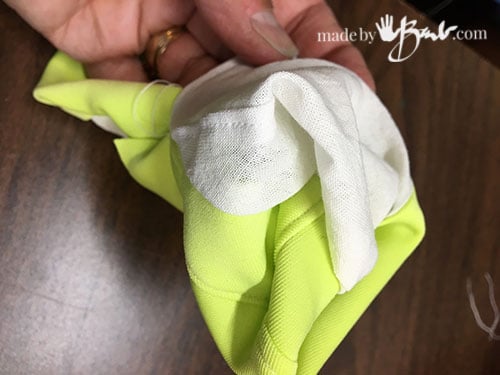
With right side together sew the bottom seam again folding back the lining sides.
Step 8:
Turn right side out.

Carefully fold bottom and top edges.

Step 9:
I top stitch the bottom chin edge to keep it flat.

Step 10:
Fold inward and stitch the casing with straight or zigzag stitch.

Step 11:
I have started to not use elastic due to the irritation it can give and also I like to use up what I have. Cutting t-shirt fabric 3/4″ (across the knit) or so will make a nice round somewhat stretchy cord that is soft.

This fabric had so much stretch that I just used a strip as a tie.

Oh the stash of fabric remnants I have… Now I can have a mask to match each garment I had sewn prior.

This DIY Ultimate Fitted Face Mask pattern fixes some of the design challenges of the chin fit as well as the room for lips & nose. The nose bridge does not have a seam so it can be very flat incase your glasses it on top. All these make a little difference but over hours could be annoying.
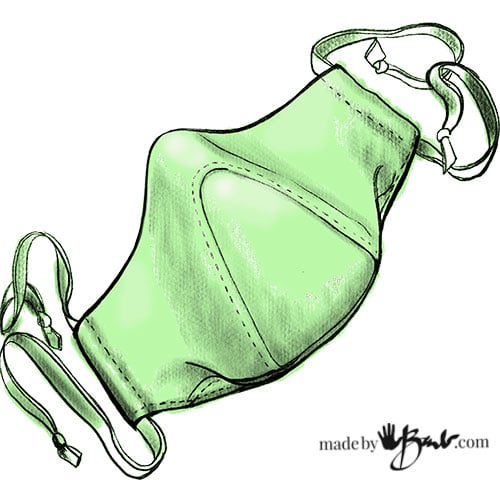
When you make a mask for the first time for yourself, test the piece before you put the lining in. Adjustments can be made by slightly adjusting seam allowances as well or printing the pattern at a slightly smaller size.

I have been enjoying some sketching again as that’s how I best visualize all those ideas floating around in my crazy-artist-brain! Let me know how you like your mask. Stay safe and we all look forward to the future…
Barb, go you!! Hope you are doing ok? And are safe where you R.
Thank you for all your inspiration.
Cheers,
Maria
I like the shape of the pattern. Saw some making the seam down middle then pressing both layers outwards which leaves only stitching between you and the air. The reaon it has to be tight woven cotton as per guidelines of CDC report is because it stops droplets at .3 microns. Sadly or stupidly th report has a first chart that everyone shared that shows first testing that tshirt material did that better but not in terms with covid 19. The next 35 large paragraphs show why they move tshirts to absolute bottom and cotton weave to top. Easy way to tell is hold up to light. Or a desk lamp. If you see light get through cannot use. For droplets in or out. There is no do what you feel ots science. Covid 19 is .1 to .05 microns. Half a micron but it exists mainly in droplets. N95 masks are only. 1. Ther is No mask material at .05 except forest fighters plastic cone types which Calif lent to our Los Angeles hospitals. Its not about thick or thin. Sweatshirt material is knit. Still would let droplets in. Athletic wear is purposely porous to let swear out. Why they say it wicks and keeps you cool. Using any athletic wear fabric is exactly counter productive. Plus in talking to a nurse in new York who started a sewing group. Told me I’m exactly correct. They are now ironing the cotton after bleach soaking 30 mins and washing and drying. Covid lives from 40 degrees to 149 in labs. Dryers go to only 129. Irons are up around 400 degrees. If I’m out 5 mins and no one sneezed around me I re iron my mask every time. I did switch to poly cotton 60/40 tshirts cut and rolled for ear ties. Besides hurting it doesn’t survive bleach washing and ironing. Most high poly materials also cannot be ironed. After reading 100s of science articles and watched more than that of YouTube makers from beginning I made end casings.. Then supply a long string if anyone wants to change out the ear ties. I make a pleated version and a sqaure version designed by a nurse. Going to work on a more shaped one. But again your pattern is great. Just materials not recommended.
Thanks for chiming in! I DO want people to make their own decisions! The basic cloth masks are more about protecting others from your particles as I understand. Much careful fabric/material choice would be needed for N95 equivalent. As for ironing, if you use a ‘press-cloth’ it does help stop the melting onto the iron. Stay safer 😷
If you could use a HEPA allergen vacuum bag for these and double stitch the boarders, it would improve the filtration of the mask by a lot. Just make sure you separate the layers and cut the plastic from the bag w/o cutting the seam of the bag (use the natural seals where possible.)
I came across a study that tested several fabrics and their efficacy compared to an N95. There are a few fabric combinations that are better than N95!
Here’s a link to the article
https://www.textileworld.com/textile-world/2020/06/face-masks-constructed-with-akas-textiles-fabrics-outperforms-n95-respirator-in-university-test/
Here’s a link to the study;
https://pubs.acs.org/doi/10.1021/acsnano.0c03972
Here’s a link to buy fabric cited in the paper:
https://www.wazoodle.com/face-mask-fabrics.html
Here’s a link to buy masks already made with the fabric cited in the paper:
https://silverarch.io/shop/category/face-masks
Hope you find this useful to your quest for the perfect mask.
I bought one of these masks to protect me from the smoke in California. The day I ordered it the air quality was 178 – hazardous. Air quality all week had been in the hazardous range – even up to 230. The day after I ordered my mask our air quality was suddenly 23!- good! Murphy’s law at work. So next time the air is bad I’ll buy another mask with the hope that Murphy will step in again and clear the air for everyone. :-))
Thanks! Navigating the ‘fabric choice’ issue is endless I find. Good luck with the air quality!
I have a .net suffix in my email address. I can’t download the pdf. Says not a valid address. Pls help.
Sent
Great mask and I love your sketch of you in it! Wonderful idea to help you and others stay safe.
Polyester and silk are not great choices for a pandemic mask. There are other articles out there but this is the most recent.
https://www.huffingtonpost.ca/entry/best-coronavirus-face-mask-materials-new-study_l_5e99b576c5b6a92100e63129
I think choices are evolving all the time and I hope everyone uses their choices for the fabric as they research. I do know that in asian cultures they have been wearing masks for many years already as a courteous way of not spreading their colds etc and have not been using cotton completely. Also, the non-woven polypropylene is also not a natural fibre like cotton. Stay Safe!
Hi Barb. Hope you are well. I’ve been trying to download the pattern for your DIY Ultimate Fitted Face Mask but I can’t get it to download. I’ve even tried every download button. Could you please help me?
Sent… enjoy!
oMg … this mask is a fantastic form and function fashion statement!
YOUR gorgeous fabrics are total runway material
AND seeing the artist actually sacrificing themselves for their art
AND what an excellent lesson in pattern-making!
AND … those poignant self-portraits … so avant-garde
Thanks so much Brenda!! It’s the ‘Da Vinci’ coming out in me! Much more fun than my usual drawing lessons! Hope my scary ‘mug’ doesn’t put off readers!
Hello…my name is April I live in Canada and was just curious I do not own a sewing machine as I’m a single divorced mother of a 16 yr old son ..is there anyway I can make these masks and sew by hand? I do love to sew but cannot afford a machine. If so ; do you have any patterns for hand sewing? I also love to make pillows. Hope you are staying safe and are well. Hope to hear from you soon.
You could use a fabric that doesn’t fray too much, as finishing the edges is the hardest part. The first mask pattern is quite easy as it has a centre seam. Just make sure you do a lot of little stitches. I like to use a fold over casing to thread the strap through and use t-shirt fabric cut in strips.You may also look on local selling sites as many home sewers are selling them.
Perfect! Being a theatrical costumer, duct-taping over a tee-shirt or socks is how I have made bodices and custom boots for 50 years. This is a lovely design! I love the inset! This style is better for folks with asthma and other sinus conditions. You will still warm the breath and make sinuses run for many, but it won’t be putting pressure on the nose which is more irritating for some. Note: with some minor alteration at the sides of cheeks, you can forget the “over the ear” thing completely and go one wide strap around the neck that goes under the ears and velcros. I have small ears and cannot wear a mask that hooks on the ears, they constantly come loose. You can also merge the upper and lower ties behind the ears into a single wide strap that fits much better. Luckily, I’m also a wood worker, so I have had time to try different styles over the years. Love my RZ and re-engineered Vog for light work.
Not sure what the equipment is but yes, you understand form! I believe it’s natural for an artist to be inquisitive about form and pattern. It’s part of drawing as well. I keep looking at all the masks on people when I am out and think… it could be better! Next may be one with stiffening 🤷🏻♀️
Barb, love the design of the mask and as well your artistic drawing skills! I will be trying this out as I finally got to get fabric today! Yeah!!!
Thanks! Drawing and designing are my ‘happy place’ I hope you like it! I wish I could limit to one pattern…🤪
Just . . . . .wow.
And Thank You!
Non so che dire….eccezionale tutorial, molto bella la mascherina e molto bella la modella. Bellissimi gli schizzi!!!! Proverò anche questa mascherina…..Grazie, grazie e mille volte grazie……
Un caro saluto dall’Italia, qui le cose vanno un pochino meglio soprattutto nella nostra regione e speriamo che continui così per ritornare alla normalità che, sono sicura, non sarà più come prima. Riguardati…….E alla prossima…….
Hi Barb, Thank you so much for taking the time and making the decision to improve your original face mask patter which I really liked. I am going to make this one to see which one I like better. FYI, I use the small round elastic cord for the ear straps. As a matter of fact the length I used was off of a package wrap that I saved and is gold. I may not wear the mask as long as some people but the ear straps have never bothered me.. I also use fusible interfacing between the fabric and lining for an extra barrier. I read that the interfacing because it is non woven works similar to a filter. If you use stretch knit you may not was to use the fusible kind. I have washed the mask several times and it has kept its shape and not bunched up because of the interfacing. Stay safe, stay well.