
The Story of My Big Collection of Sewing Machines

Please, tell me I’m not alone… I have a ‘few’ sewing machines! (There, I said it) With all my creative and practical projects I hope I’m inspiring you to consider ownership of this great tool as well. Perhaps my wish is that everyone have at least one sewing machine. Here’s the Story of My Collection of Sewing Machines

Why should anyone have that many sewing machines?!
For avid sewing enthusiasts, the allure of a collection of sewing machines goes beyond mere functionality. I took a count and I have 10 (actually 13 with the ones I’m going to part with)! ‘Even I shook my head when I realized! Each machine does tell a story, represents a unique set of capabilities, and adds a layer of creativity to the art of sewing. In this blog post, we’ll explore why having a collection of sewing machines is a delightful pursuit that enhances your crafting experience and opens up a world of possibilities.

Whether or not it’s “great” to have a collection of sewing machines depends heavily on your individual motivations and circumstances. Here are some potential pros and cons to consider:
- Versatility: Different machines excel at different tasks. Having a collection could provide options for heavy-duty projects, delicate fabrics, specific stitches, or embroidery.
- Historical interest: Vintage sewing machines offer a connection to the past, showcasing craftsmanship and engineering advancements. They can be beautiful decorative pieces and conversation starters.
- Learning opportunities: Working with various machines can deepen your understanding of sewing mechanics and improve your troubleshooting skills.
- Sustainability: Upcycling vintage machines prevents them from ending up in landfills and gives them a new life.
- Investment potential: Certain vintage models can appreciate in value, especially if rare or well-maintained.
Cleaning, Organizing & taking stock of my Machines

#1 – Kenmore 158.19312
How it started when I was a child:
A lot of this seems to stem back to my very young days. Yes, I know, I sometimes forget about yesterday but do remember over 50 years ago! I cherish those days when I would watch my mom sew meticulously, either clothes for us or hats for clients (she was a milliner) I honestly think a child absorbs so much just by watching with interest. She never really insisted I sew but since I saw the amazing things she made I also wanted to join in!
I was quite young so they bought me a toy machine that was supposed to sew with a chain stitch. I struggled and complained so much! Finally when I was 12 I got a new first machine for my birthday; a basic Kenmore 158.13200 for myself – and that was the start! My parents made a deal with me that I could have the government child bonus money if I made my own clothes; I was so excited. It had basic straight, zigzag and stretch stitches.
The above machine is a vintage Kenmore 158.19312 (produced in mid 1972- 1974) It is my main ‘workhorse’ that also allows ‘cams’ to be inserted for a variety of embroidery stitches. I bought it used in a cabinet for $50 about 20 years ago when my original one was growing weary. It is a relative of my first one. It has been flawless, for all my ‘maker’ projects, quilting, just the ‘perfect’ machine.
This wondrous tool will sew through leather, denim and even sew rope to make bowls! They are heavy metal machines that last forever.

#2 – Pfaff Hobbymatic 955
Deal of the Century:
Thrift stores are the greatest to find vintage machines! I have never bought a ‘new’ machine. This one was $8 since it was seized. Someone probably never used it so the oil solidified. All the attachments, book and even bill of sale was included.
How to fix a seized Sewing machine:
Nope, I am not a trained sewing machine repair professional but have managed to get quite a few machines going. The risk is pretty minimal when a machine only costs $20. Every machine I have found that needs some encouragement to hum again has not needed mechanical repair. Stay away from rusty ones though.
I start by oiling parts (with quality sewing machine oil) that move or turn. Most older machines have access panels to get to internal parts. If they still are not freely moving with coaxing apply a bit of heat. The old oil gets gummy but the warm heat of a blower dryer will help it soften to allow the new oil to do it’s job. It is so gratifying to get it humming again.

I love this Pfaff brand as it is made in Germany. The bonus of this Pfaff Hobbymatic 955 machine is the dual feed ( means that the top also pushes the fabric, not just the bottom feed dogs). It is wonderful for garment sewing and FME ( free motion embroidery)

#3 – Pfaff Stretch 297-1
Another Heavy Duty Pfaff:
This is another super heavy vintage machine (30 pounds or so) and all metal. Sewing machines come in different height shanks, this one is a low shank. That means many of the attachments and presser feet will fit. Thanks to mom I do have a bunch of attachments, they help to hem, finish edges, ruffle and pleat, even push the fabric… (more on those later)
When doing Free-motion-embroidery it helps to have a large flat surface, and this one has a detachable one!

#4 – Janome My Lock 234D
Any self-respecting sewist (sewer does not sound right) will need a serger! If you like to quickly stitch up a knit fabric this will sew the seam, cut excess off and overcast the edge. It is a 4 thread Janome My Lock 234D that also will adjust how much the top and bottom fabric feed (called differential). Since it was also seized and peddle was missing I also paid $8 for it, can you imagine! Peddles are pretty easy to order online. It’s reliable machine once it was coaxed with heat & oiled.

#5 – BabyLock BL3-416 & #6 – Baby lock 418
My first serger was a 3 thread Baby Lock. I didn’t have much knowledge about them but did end being lucky to make so much of my young kids clothing. These small metal machines have a good reputation. I think they are made by Juki, a brand (well known for their industrial machines) I’d love to pick up some day!
Love these Sewing Machines too!

#7 – Husqvarna 21E Automatic
I was jumping with excitement when I happened on this machine; another thrift find! It comes in a cute gingham lined carry case. It’s made in the early 60’s in Sweden. These machines have a lever that will allow you to change the gear drive for more strength. I was so thrilled that it still had the instruction booklet boasting the ability to sew leather. Mine is missing the large sewing bed that would aid when doing FME on it. Funny, these don’t sound like other sewing machines; more industrial.
After it probably sat for decades I also needed to use some heat to un-seize some of the dials but there’s often common things that are searchable online for help. I think of it like the way men tend to like to talk/share about cars and we have sewing machines!

# 8 – Kenmore 158.1040 & #9 – Kenmore 385.17627
‘Awaiting their turns…
This greenish machine is a lightweight Japanese 3/4 size machine that only weighs 17 pounds. It’s lovely since it’s unique case has roses on it. I imagine it would be a good machine to take along! It sadly sits waiting for that day…
The White Kenmore 385.17627 (behind) is a more modern machine with plastic parts. The manufacturing date is probably more towards the 8o’s. It works well, but I feel less confident about putting it to strenuous use. For the average person who just needs to hem the odd clothes or sew a blouse it would be fine. Personally I also do not like the drop-in bobbin types; perhaps because I learnt on the lower bobbin machine, where all parts are metal.

#10 – Kenmore 30 Stitch 385.1884180
Another of the newer early ’90s Janome-manufactured Kenmores, it boasts 30 different stitches. The accessory box slides off to enable free-arm sewing (in things like sleeves) It’s also a drop-in bobbin with low shank presser foot. It was easy to check out after another cheap thrift store deal, as I have never paid more than $30 for a sewing machine!
Ok, yes, there are a couple/few that are going to need a new home… ads to posted soon!
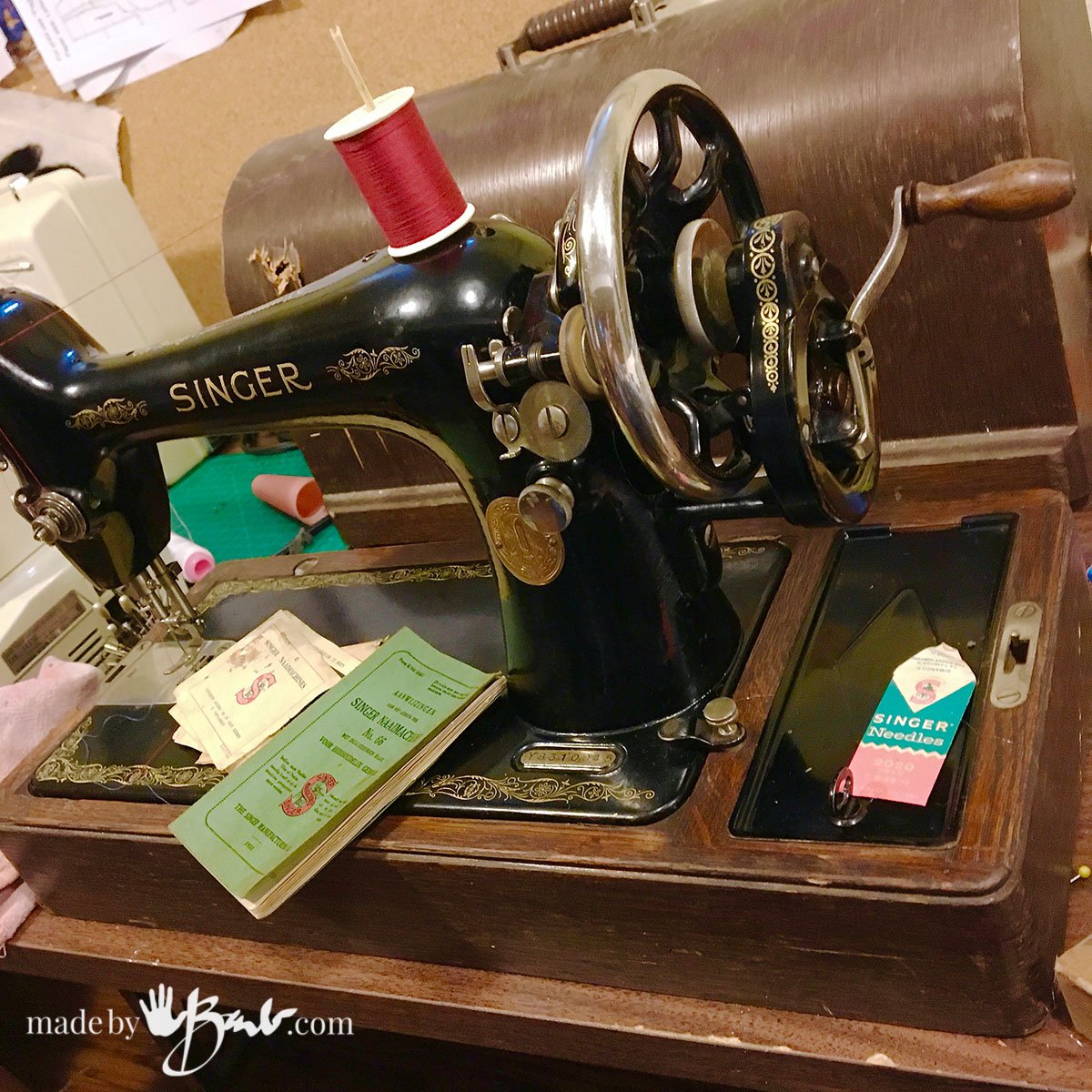
#11 – Singer 99 Hand Crank
This machine is ready for the day the electricity goes off… It’s a lovely testament to history, design & craftmanship, complete with it’s bentwood case. Amazingly a model from 1922 that still had it’s book, accessories and key (tagged ‘Oma’s machine) was just dropped off at a thrift store. Again since it was seized I snagged it for $10! It sits on my cabinet as a piece of art!
#12, #13, #14… oh boy!
My mom’s first Kenmore (another 158.xxx) will be finding a new home as it needs a new motor. It must have millions of miles on it! I’ve also got a Singer treadle sewing machine that I forget about since I use the furniture piece as a server in the dining room.
Create your Organized Workspace:

If your space is organized it’s a much better experience. I love the clean look so I have painted the sewing cabinets white (painting furniture white) and lined up my 4 favourite machines (and a second serger for light thread). I often see cabinets looking for new homes. Once updated with modern colour they are quite convenient & do not take much space. Open the table, raise the machine and setup is quick compared to lugging out and setting up a machine…
Conclusion:
In the world of sewing, a collection of machines is more than a practical investment; it’s a celebration of craftsmanship, creativity, and the joy of sewing, not to mention the thrill of finding a deal. Whether you’re drawn to the advanced features of modern machines, the nostalgia of vintage models, or a combination of both, your collection becomes a testament to the artistry and versatility inherent in the sewing world. So, embrace the diversity of your sewing machine collection and let it be a source of inspiration and endless creative possibilities in your crafting journey. Happy sewing! Imagine all you can do with a sewing machine… especially old machines, maybe you’ll become a collector too!
Comment below to let me know what you have & love…
I came across your blog while deep diving into the history of my machine. I have a Kenmore 385.1884180. It was a gift. I love this machine. I’ve sewn garments, mended things, and of late, made quilts with it. Any issues I have had with it have been of my own doing, and easily remedied. If it ever irreversibly quits on me, I will cry.
I hope it never has an issue. Mine go on forever it seems! I love them, use it almost every week!