
Colourful Cochineal Eco Print


It never ceases to amaze me what treasures that ‘Mother’ nature has up her sleeves! As I fall deeper into that obsession of dyeing and printing with natural materials I discover even more wonderment! Combining some pre-dyeing with eco printing leads to a colour explosion. Let me introduce you to Colourful Cochineal Eco Printing!

It always amazing me how I get drawn it… On a recent trip to a small shop with all kinds of fibre and dyeing goodies I went berserk! I was on a mission to get some indigo (more on that soon) but I found something else; small little bugs!
What the heck is Cochineal?!
Cochineal is a tiny tropical scale insect which creates natural carmine dye. Amazingly, there it was, a little container of dried tiny tiny bugs. And according to the knowledgable fellow it is an amazing dye that gives great colour. I was quite intrigued!
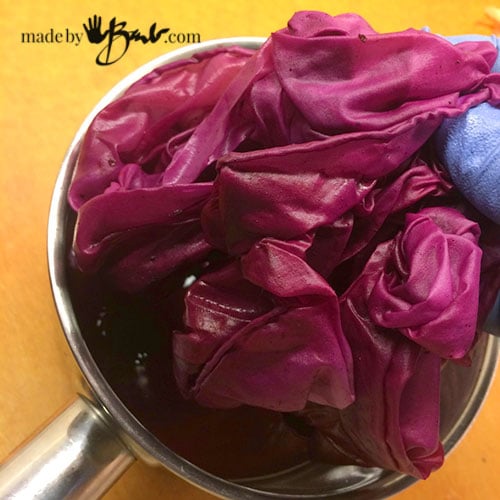
Cochineal is known to give much colour for the small amount of material. As little as 3% of the weight of fibre that you are dyeing can give good colour (calculate weight of material against weight of cochineal) 10-20% will give string colour.
How to use Cochineal
The little dry carcasses (don’t worry, you can’t really see any arms and legs) can be ground up either in a mortar and pestle or a coffee grinder as this is a food safe anyway.
It grinds quite small so it can be used as is or strained out of the water. I have tried both methods with success. I use a scrap of organza as a fine mesh strainer similar to making tea.
Once the dye water has been made I add my silk fabric to the pot and slowly bring it to a low simmer. Heat can kill the colour so I’d rather bring it to a low simmer gradually. I hold the heat for about an hour and then let it sit and cool over night to set even more colour.
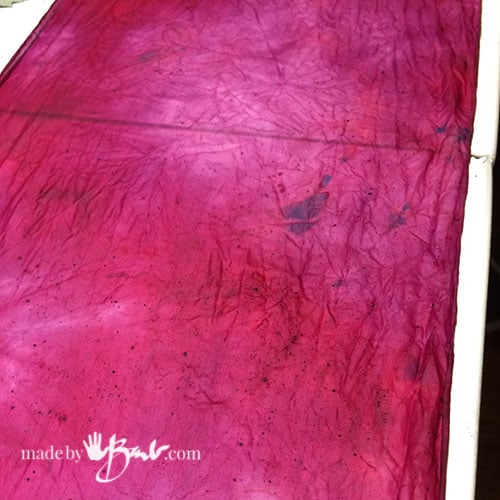
Lovely strong pink! Note the dark specks? Those are the residue of ground cochineal. They may give some darker spots so you may want to strain the dye-water. I am not too concerned with perfect even colour.

The Bundling
I rely on my favourite leaves to print; sumac and maple. These were used fresh however dried can also work. As stated in the introduction you will need something to wrap the layers around.

Lay the silk flat and place the leaves. The fronts and back print differently so vary the pattern as you like. This method does not dip the leaves in iron water.

The key is to have everything as smooth and flat as possible for defined prints.
Rather than soaking/dipping the leaves in an iron-water solution I use an iron blanket here. Old cotton sheets ripped into strips are soaked in a weak iron-water and wrung out well. This way the iron comes into contact around the leaves rather than on them. It is then carefully laid over the leaves.
As a barrier to stop bleed-through another layer of plastic is placed above the iron blanket. (strips cut from drop sheet plastic can be tailored to the right width) Flatten and smooth before rolling tightly.

The bundles are then wrapped with string and ready for the pot.
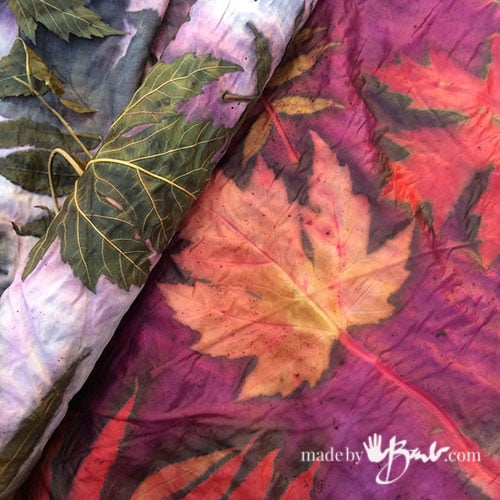
Be aware that this instruction shows how it has worked great for me however results may vary according to many factors. The iron-water strength, the leaves, the fabric, the water PH, all play some role in the final outcome. But that is what makes it interesting! It truly is ONE OF A KIND!
The Eco Print Processing
I prefer to steam my bundles as then there is less water and also less darkening at the ends of the rolls. These have been steamed outside on a BBQ side burner in an aluminum lidded roaster. Make sure to check that the water does not disappear! I steam for about 2 hours. I can usually start to smell some odd aroma from the leaves ‘cooking’.

When I unrolled my first Cochineal dyed piece I almost lost my mind with the amazing colours! I was hooked even more now! I can barely keep up with buying silk…
To allow a bit longer chance of picking up colour I sometimes place the steamed rolls in a blanket as they will hold the heat and ‘process’ even longer. Once cool they can be unrolled.
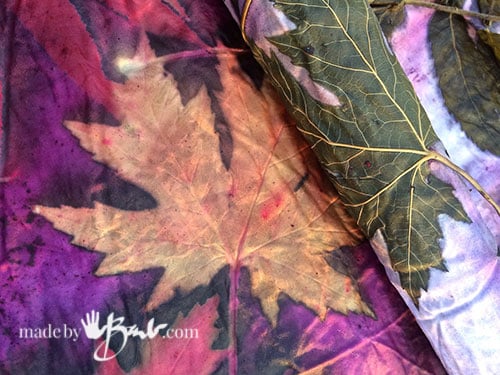
Go ahead… Do a ‘happy dance’! I am sure that I did! As an artist who has painted for so many years of my career this just astonished me so much. The variation of the pinks and purples and reds! I believe (no chemistry degree here) that it is all about the acid and alkali reacting with the dye. Many reds change according to acidity as seen with red cabbage. Cochineal however is not fugitive and has great lasting ability.

Once dried and ironed I can’t seem to stop looking at it…

…or taking pictures!

Oh, by the way, my apologies to the little cochineal fellows (actually it’s the females, figures)! Take comfort in the fact that your ‘colour’ shines on for many years to come and we will be in constant awe of your amazing abilities! Thank you!
And thank you to my readers for joining me…
I thoroughly enjoyed your tutorial on dying with the cochineal bug. You’ve so inspired me I can’t wait to give it a try. Thank you so much for sharing this dying process. I love your e-mails and what you create. You’re truly an artist in so many venues.
It is an elusive art form so I suggest tests and experiments with your own materials. Any eco-printer will tell you that! And many will not divulge any secrets… Good luck and let me know
Barb, you are a very generous and creative artist. Eco-printing and botanical dyeing is magical and results unpredictable. As you said, not all practicing this art will share their process. Thank you.
Thanks! It’s a lot of hard work to keep this site going! I’m still hoping it will eventually be worthwhile… It’s a good thing that I like what I do! Happy printing!
Thanks for your instructions, rushing around collecting rusty nails.
Fun stuff! Do make some tests with your specific conditions… Happy printing!
Barb,
I was absolutely gob-smacked when I reviewed your article, dyeing with cochineal bugs, maple leaves, sumak leaves. It is obvious, your thought processes are truly magical. Yes, I have read some of your comments & looked at very few of your downloads but, what I read & saw impressed me. You are a “pioneering woman” with many talents. Therefore, go forth & create. It’s apparently obvious you are very talented person. I will eagerly look forward to my copy of your newsletter. Thank you.
Sincerely,
Deb
PS: Where would I obtain my own stash of Cochineal Bugs?
I have ordered the little bugs from Dharma Trading and also from Fibre Garden here in Canada. Thanks for the kind words!
Hi Barb, your tutorial is just amazing. I had no idea about eco printing but reading your page I am totally into in. I made 2/3 items. I am happy with chiffons scarf resul but not other pieces. I am not getting clear print. But again I did not use any alum as a mordant only dipped leaves in iron water. I love your work. Your pink silk scarp is awesome. I want to make one of that.
You are an amazing teacher and artist.
I love and do different art. Now I am into eco printing. I want to learn the proper way of doing it.
Thanks so much. Banasree
It is a wonderful art form but it is a bit illusive sometimes due to the precise (more like magical) chemistry and science going on! Experiment and embrace all the interesting results! If you want predictable just paint silk… Happy Eco printing
Can I ask how once you have finished your Eco print and your cochineal eco prints on silk do you fix it, to make sure it doesn’t wash out?
Loving what you do, you truly are inspirational
Thank you
From Vicky in Settle Uk
The use of the iron and the tannins creates a permanent print. Wash a few times with PH neutral soap and it is done. You can also dip in a little baking soda solution to neutralize from the iron. Silk dyes very well…
Your work is absolutely stunning!
My question is whether there is any special care or finishing to preserve the colors? And, I would assume something like a scarf would need hand washing? I’ve worked with many fabrics, but not silk. Wouldn’t even know where to buy it or what to look for. Any tips?
Thanks so much for your inspiration..
Anne
I am in love and I always thought I would enjoy textile art/dying etc. My creativity with fabrics has been somewhat satisfied with my custom embroidery business. I do have some questions.
What is your iron solution? Where do you buy the cochineal critters? How long did
you let the bundles steam? I’m sure I will think of more😉.
Thank You,
Kathy Ziegenmier
STL Stitch Art
Guten Tag? I’m guessing… I got the cochineal at a shop near me but you can order from the natural dye suppliers too. They don’t weigh much. I steamed the bundles for about 2 hours. I should add that. Oh, so much to do… The iron solution is made with vinegar, water and rusty iron. You may want to see the other posts as well.
Barb, I love your website and all of your artistic, creative endeavours. I’m not an artist or even a diyer but you give me inspiration and maybe when I feel less anxious I will dip my feet in the magic waters.
Kind regards.
Sue
It can be quite a rewarding type of DIY and can also be quite inexpensive if you start simple. My first eco prints were on old bed sheets. Before you know it you will be looking at everything as a possible printing material… Good luck! Glad I inspired you!
Love this! Thanks so much for posting. I’m currently under snow so will be using dried flowers/ leaves. One question: is the iron the only mordant that you use, or did you pre mordant with some alum? Thanks!
Yes, I’m under snow too! The silk can be quickly prepared with some soak in a vinegar (50%-50%). I bet I sometimes just forgot. Silk dyes/prints so easily in most cases!
Hi Barb, and thank you so much for the info about chocineal! You said you out strips of plastic on top of the leaves and then rolled them around a stick it pole. Is this so the leaf prints do not bleed into each other? And was the dye water able to get through the layers of plastic? I rust pieces,due fabric and do I digo but haven’t tried cochineal! Thanks!!
Regina: If you notice in the picture the silk is already dyed with the cochineal prior layering and rolling. Yes, the plastic prevents bleed through. I steamed them afterward. Good luck
If you notice in the picture the silk is dyed prior to rolling and steaming. Yes, the plastic acts as a barrier to prevent bleed-through. Good luck!
Would this work on paper? I worked with fabric for most of my life. In my 70’s now I am drawn to working on paper. I am currently strengthening some papers with konnyuka flour paste. Any tips appreciated!
I have just recently started printing on paper. I did not need to strengthen them but they were also not that large. The principles of eco printing on cotton are closest to paper since its a rag content paper usually. You can see some images on my instagram…
Yes, it’s a fun inexpensive way to get cool results.
Thank you for sharing your beautiful cochineal eco dye project! I love working with cochineal but I haven’t tried your process yet – I can hardly wait!
Sincerely
Janie
I must say, it’s the most fun one that I’ve done. Now that christmas is done, I can now get back to more of it… Hope you join in the magic!
You are so right on in your tutorial and generous in sharing your knowledge! I’ve done this for years and I am a firm believer in “just do it.”There are no guarantees. You just have to start! It is so easy to over complicate things with too much thinking 🙂 .I too have painted (making a living as a portrait artist) for 30 years But I must say the ecoprinting art form has captivated me with its unpredictability-it truly is, more or less, random and I like to celebrate any results with the knowledge that whatever prints I achieved were the gifts Mother Nature bestowed on me with her plants on that day :-). There is a movement in some Ecoprinting groups towards complicated, multi-steps, chemical analysis, etc, etc but like you, I’m all for letting Nature do the work :-). I am making a small donation to your knowledge fund! Can’t wait to see what you do when Spring comes lol
It is funny as I noticed that you are an artist too! There’s something about just putting paint on a canvas, but when the co print just turns out great it seems to be a bigger accomplishment! Funny! Thanks for the donation! This site is quite the labour of love! I love your creativity and am jealous of the rustic life with chickens you have…
Beautiful work, Barb! Thanks so much for sharing your techniques. Wondering if you have tried this process with alkinet-dyed silk. Mine attempt was not successful, but I did not use the iron blanket.
Thanks! Hmmm, alkinet has not been on my radar. I’ll have to look into that. I already have a lot of buckets and jars of dye… as I bet you do too! Seems that this elusive art form keeps tempting us.