
Colourful Cochineal Eco Print


It never ceases to amaze me what treasures that ‘Mother’ nature has up her sleeves! As I fall deeper into that obsession of dyeing and printing with natural materials I discover even more wonderment! Combining some pre-dyeing with eco printing leads to a colour explosion. Let me introduce you to Colourful Cochineal Eco Printing!

It always amazing me how I get drawn it… On a recent trip to a small shop with all kinds of fibre and dyeing goodies I went berserk! I was on a mission to get some indigo (more on that soon) but I found something else; small little bugs!
What the heck is Cochineal?!
Cochineal is a tiny tropical scale insect which creates natural carmine dye. Amazingly, there it was, a little container of dried tiny tiny bugs. And according to the knowledgable fellow it is an amazing dye that gives great colour. I was quite intrigued!
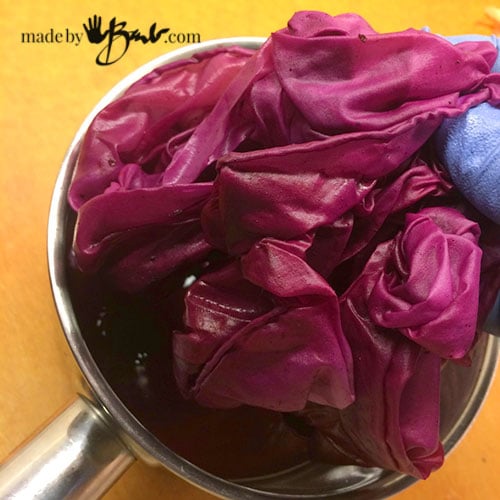
Cochineal is known to give much colour for the small amount of material. As little as 3% of the weight of fibre that you are dyeing can give good colour (calculate weight of material against weight of cochineal) 10-20% will give string colour.
How to use Cochineal
The little dry carcasses (don’t worry, you can’t really see any arms and legs) can be ground up either in a mortar and pestle or a coffee grinder as this is a food safe anyway.
It grinds quite small so it can be used as is or strained out of the water. I have tried both methods with success. I use a scrap of organza as a fine mesh strainer similar to making tea.
Once the dye water has been made I add my silk fabric to the pot and slowly bring it to a low simmer. Heat can kill the colour so I’d rather bring it to a low simmer gradually. I hold the heat for about an hour and then let it sit and cool over night to set even more colour.
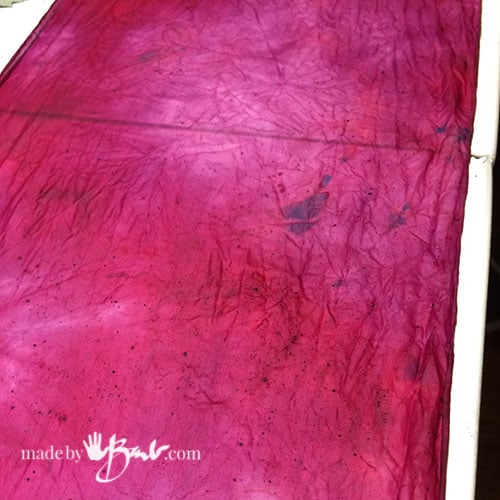
Lovely strong pink! Note the dark specks? Those are the residue of ground cochineal. They may give some darker spots so you may want to strain the dye-water. I am not too concerned with perfect even colour.

The Bundling
I rely on my favourite leaves to print; sumac and maple. These were used fresh however dried can also work. As stated in the introduction you will need something to wrap the layers around.

Lay the silk flat and place the leaves. The fronts and back print differently so vary the pattern as you like. This method does not dip the leaves in iron water.

The key is to have everything as smooth and flat as possible for defined prints.
Rather than soaking/dipping the leaves in an iron-water solution I use an iron blanket here. Old cotton sheets ripped into strips are soaked in a weak iron-water and wrung out well. This way the iron comes into contact around the leaves rather than on them. It is then carefully laid over the leaves.
As a barrier to stop bleed-through another layer of plastic is placed above the iron blanket. (strips cut from drop sheet plastic can be tailored to the right width) Flatten and smooth before rolling tightly.

The bundles are then wrapped with string and ready for the pot.
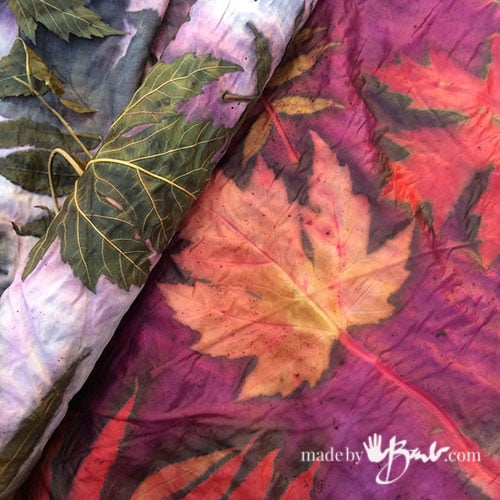
Be aware that this instruction shows how it has worked great for me however results may vary according to many factors. The iron-water strength, the leaves, the fabric, the water PH, all play some role in the final outcome. But that is what makes it interesting! It truly is ONE OF A KIND!
The Eco Print Processing
I prefer to steam my bundles as then there is less water and also less darkening at the ends of the rolls. These have been steamed outside on a BBQ side burner in an aluminum lidded roaster. Make sure to check that the water does not disappear! I steam for about 2 hours. I can usually start to smell some odd aroma from the leaves ‘cooking’.

When I unrolled my first Cochineal dyed piece I almost lost my mind with the amazing colours! I was hooked even more now! I can barely keep up with buying silk…
To allow a bit longer chance of picking up colour I sometimes place the steamed rolls in a blanket as they will hold the heat and ‘process’ even longer. Once cool they can be unrolled.
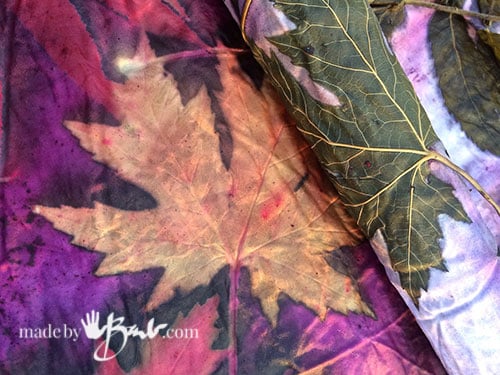
Go ahead… Do a ‘happy dance’! I am sure that I did! As an artist who has painted for so many years of my career this just astonished me so much. The variation of the pinks and purples and reds! I believe (no chemistry degree here) that it is all about the acid and alkali reacting with the dye. Many reds change according to acidity as seen with red cabbage. Cochineal however is not fugitive and has great lasting ability.

Once dried and ironed I can’t seem to stop looking at it…

…or taking pictures!

Oh, by the way, my apologies to the little cochineal fellows (actually it’s the females, figures)! Take comfort in the fact that your ‘colour’ shines on for many years to come and we will be in constant awe of your amazing abilities! Thank you!
And thank you to my readers for joining me…
Hello Ms. Barbara,
My name is Kanami.
I sent you an e-mail couple of days ago. I was wondering if you received it.
Here’s the e-mail I sent you.
I’m currently trying to translate your Wool and Cochineal Eco printing pages into Japanese.
I have a couple of questions I wanted to ask you.
(Wonderful Wool Eco Printing)
“Wonderful Wool”
To make a normal iron mordant about how many railroad spikes do you use? And about how long do you leave them in the water ?
“Rolling”&”Processing”
「to leave some wool exposed to create interesting edge design by IMMERSE BOILING in some dye color 」I was wondering what you meant by “leave some wool exposed”- do you mean when you cover the wool with plastic sheets, before rolling the blanket up, to leave the edges exposed? I also wasn’t sure what you meant by the twine/ string acting as a “resist” to create a fringe design. How does this work? And what kind of fringe designs does it make?
(Cochineal)
“What the heck is Cochineal?”
「Heat can kill the color」how should we slowly bring it to a “low simmer “ if heat can effect the color ?
“The bundling”
to make “weak iron water”, how many rusty metal rods should we use and for how long?
“The eco print process”
You mentioned steaming the bundles in an aluminum lidded roaster. I was wondering how much water should be used? and do you have to keep the bundles off the bottom of the pot? or is it ok if we put the bundles directly in the water?
Also, do you recommend only using silk for cochineal eco printing?
Thank you so much for your help!
Sincerely,
Kanami Sudo
Yes, I did send you a reply with many answers. check your email and possibly your spam/trash box…
would you please send me the answers to Kanami Sudo’s questions. I was asking myself the same thing thanks
I am so interested in natural dying and want to get started
Answered as best I can… do some experimenting. You just never know exactly what you will get!
Well, I will try to answer as best I can. You do realize that many eco printers do have high priced workshops for these types of specific answers. When I started eco printing no one would share any detailed info.
– To make a normal iron mordant about how many railroad spikes do you use? And about how long do you leave them in the water ? That is something I did not measure and it is determined by doing small test prints to see how strong the iron is.
– to leave some wool exposed to create interesting edge design by IMMERSE BOILING in some dye color 」I was wondering what you meant by “leave some wool exposed”- do you mean when you cover the wool with plastic sheets, before rolling the blanket up, to leave the edges exposed? I also wasn’t sure what you meant by the twine/ string acting as a “resist” to create a fringe design. How does this work? And what kind of fringe designs does it make? My wool jacket has some string marks in the sleeves as it was immersed when boiling.
– Keep Cochineal below a boiling point.
– Any vessel can boil water to create steam, keep the bundled elevated so that they only get the steam. You may also try my microwaving method If steaming make sure to keep enough and not boil dry.You can put the bundles in the water but it will give a different result. Use inexpensive fabric and do some tests, thats how I figured it out.
– Silk will print quite easily but you are not limited to silk with cochineal. I will be having another post soon with cochineal.
—Dive it (not into the pot) and try some! Happy making!
Is there any formula for eco-dying that will work on rayon and polyester vintage slips
Sadly the polyester will not take the dye. I have read that nylon will. Rayon will, but as stated you should do a few tests to see how your leaves and mordant perform. It’s the nature of this art form. ‘Hope you give it a try.
Mam….your work very amazing…I love that. Your tutorial help me advanted eco print using natural dye..
Thanks. You do lovely work as well.
Thanks for your tutorials and for sharing your wonderful works. What about ecoprint on viscose? I didn’t find any tutorials about it. Is it possible to do? Could you help me? All the best !
Viscose is also a natural fibre but made from wood. It will print as well but has it’s certain characteristics. I think it may be a bit weaker when wet so some care should be taken. But I usually just do a small test to figure out any new material.
Thank you for taking out all this mystery from the process. As you said: it is simple. That’s what I love about your tutorials: they describe the basic process with enough details to start doing it.!
As alkanet goes: I was getting very interesting purple after I soaked it in rubbing alcohol (it smells), strained it and added to the water. Instead of steaming I put my bundle into it and simmered it. Plastic I used for barrier was narrower than silk and I did not tie it all the way to the edges,. Edges were exposed and free to soak dye. Worked well with reddish maple leaves.’
Glad you are enjoying it! I’ve never read anything about using an alcohol. (be careful around flames) So many possibilities! I’m itching to get some going right now!
DO you think this would work on all cotton?? Thank you for so generously sharing your knowledge.
Cotton does print, however it needs to prepared well. Soaking in alum solution or a soy milk solution can mordant the fabric. Animal fibres (wool, silk) do print the easiest. There are more resources here Good luck, it’s a magical art form!
HI, love your technique! I am curious if you can use a proceedue to dye after, and also
if dying with pre-dyed indigo silk??? Thanks so much…our warm NZ winters are nice but no open fires are allowed so will have to use on the stove!Thanks!
I have dyed used pre-dyed with indigo and it did not ‘displace’ so it was a fairly blue outcome. However a after-dye and re-eco-print did give unexpected interesting results. It’s all experimentation…
Barb! I am so happy to have found your blog, and your eco-printing results are fab! As soon as you mentioned the little store, I thought, “ I bet I know which one!” I try to order as much as I can from there.
As a beginner, I have only tried various papers and cotton that I have, but can’t wait to try silk and wool because they give better prints, from what I have seen.
I also love the fact that you follow your heart when creating and use many mediums- a
person after my own heart! I, too, may need to start a shop because I make too much stuff-LOL.
Oh Thanks! Once you try silk you will be hooked! Everyday I want to roll up some bundles! There will be a new batch of silk scarves soon in my shop. Summer time here is best for the printing and processing! Make sure to get my new posts! Happy making!
Hello Barb!!
I found your wonderful website via Pinterest when searching for DIY information/recipes regarding eco-printing on cotton. I read your basic article on the subject and took copious notes in my new Natural Dye Notebook.
Thank you for sharing your experiences in such an easy to read, concise, tutorial-style blog. I do have one question about this particular method re dying w cochineal. I see that you used silk with AMAZING results, however do you think that I could achieve something similar with cotton?
I’m expecting a new baby girl mid 8/18 (she is our late-life baby, as we already have a 19 yr old son and 13 yr old daughter!!! 😱💕) and have been collecting white, 100% cotton garmets with the intention of dying/eco-printing them for her.
Do you think this is an appropriate method to try with cotton? Do you have any tips for success (besides scouring)?
Not sure how you answer queries, but you’re welcome to email me back. I worry if you just reply here that I may not see it unless there’s some kind of push notification that a specific reply has been made? Sorry- I’m new the commenting on blogs!! Lol!!
I apologize for the long comment and sincerely thank you for your generosity and attention to detail when sharing your skill(s). You are AWESOME!!! Bravo, brava, brava!!!!
Cheers and sincere regards,
Amber E Gibbon
Aka: zambereileen (instagram)
I could see how it would be great to do eco printing with the vast amount of choices!
I have not tried to dye cotton with cochineal. Generally cotton and viscose is harder to eco print than silk. Cotton will need more mordanting and prep than silk. Wool also dyes well. The art form of eco printing is quite mysterious and not always acting as expected. As of late I have been working with cochineal and getting different results that have been more purple. It is quite sensitive to PH so I am trying to get some reliable results. Even if you get some odd results it should still be beautiful since the pink should come through. And it is food safe!
Best thing is to dive in and do lots of testing… and don’t get too discouraged if results are not as expected. Let me know how it goes…
I like your technique of Eco Dying and am going to try it. Your scarves look lovely. I paint on silk and find it very exciting watching what happens when the dyes touch silk. Thank you for your tutorial.
It is quite exciting as you are never exactly sure how it turns out. Start by doing small tests and see more posts here Good Luck!
Hi Barb,
I am very excited to try your method of dying silk.
My question is…in using the strips of sheeting material for the blanket does it need to be:
1. 100% cotton or can it be a blend?
2. Does it need to be white or if it’s an old sheet can it have a pattern?
3. Could you clarify about how strong the iron water should be? Perhaps that might be how dark the shade of the water?
Thanks so much for your sharing.
Toni W
1. I think cotton will absorb the iron solution best but I don’t think it’s a rule.
2. If it’s white you will get some printing on it as a bonus, but you could any colour (have heard it may transfer, but I have not had it happen)
3. That’s tough if you make it with rusty things. ‘Slight rusty colour’ may be best I can say. I usually do a test run and adjust from there. Otherwise some use iron sulphate powder at certain recipes.
Perfect results may be a challenge but that is the beauty of this art form since it can give such unexpected results! Good luck