
What is Myrobalan?

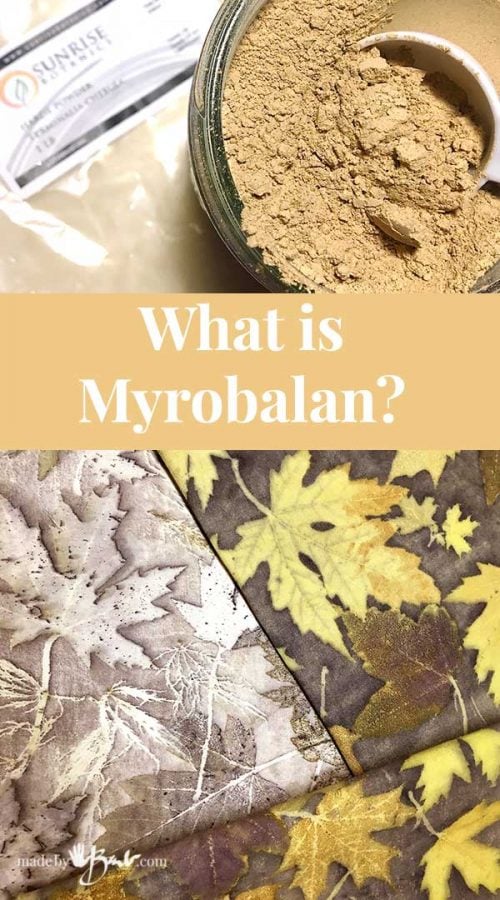
Eco printing may have your head spinning with all the variations! Well, let me introduce another amazing player to this fantastic magical game; Myrobalan. This important tannin based mordant can yield awesome results…
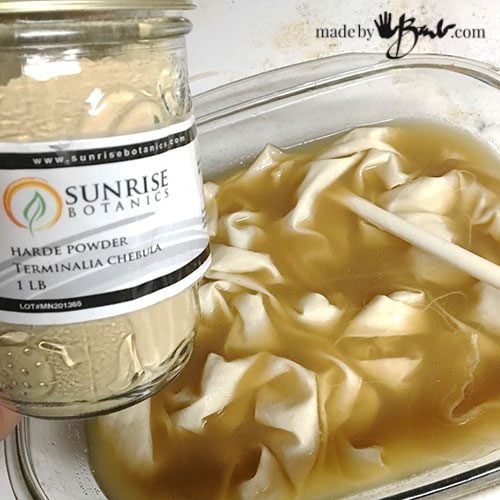
Where does Myrobalan come from?
This mystery dyestuff powder is made from the ground nuts of Terminalia chebula tree. This upright tree has lovely bright yellow flowers and can be found in the forests of diverse regions of Asia & foothills of the himalayas. It also can be found myrobalan extract and also under the name of Harde Powder. It is believed to have some interesting healing properties in traditional Indian medicine. For that reason it did not scare me as many of the other ‘chemicals’ do. ‘And it was easy & inexpensive for me to order it from a local health food supplier and also be fond at some ethnic food stores.
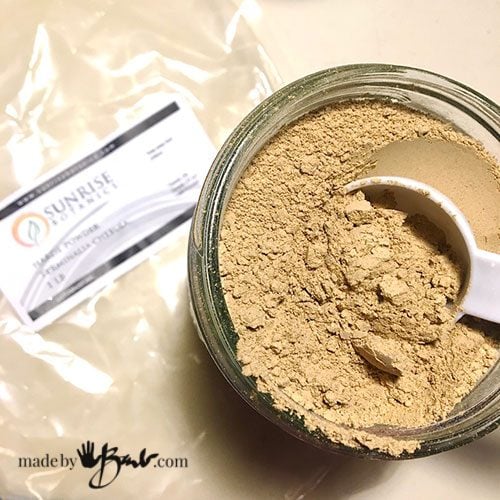
What does Myrobalan do?
This unique myrobalan powder material is both a tannin and a mordant. It is a common dye that will produce nice buttery yellow (20-30% WOF) and provide good mordant for difficult to dye cotton fibre if used before alum at 15-20% WOF; weight of fibre). Since it gives a nice warm yellow it can also be combined with indigo to further add beautiful teal color (single indigo dip).
Scientifically, Myrobalan has some key properties to help with dyeing such as Gallic and Ellagic acid; hydrolysable tannins.
Since I am a hands-on person I tend to learn more by experimenting & doing rather than by reading. For a good foundation I put it through a few tests and observed what it can do. It is interesting how many different outcomes I had.
Understanding the Challenges of Eco printing:
Achieving colours on cotton fabrics in the world of eco printing can be a bit of a challenge depending what species of leaves that you can find or what other natural dyes you add to the mix. This brownish yellow powder dyes a light buff color. Myrobalan also loves iron! Whenever there is any way of the two coming together it creates a nice purplish grey. The depth does depend on the strength of both the Myrobalan and the iron, as usual. I much prefer it to the some of the dirty types of browns that some tannins create with the saddening of iron.
These are examples of a few media including paper and Rayon (considered cellulose fibres). It’s use is not even restricted to the usual rolled bundles of Eco Printing. (watch for future detailed posts) I can also see how stable some dyes are by how much they stain my hands and also my plastic sink; wow did I need to clean!
It is so amazing to see the reaction take place! A cooled tea made from the Harde Powder (myrobalan) has some drops of a weak iron solution (iron sulfate + water) added and immediately the dark greys appear! That is how I do test some of the strength as well. Is there a definite rule? No way…
Combining Methods:
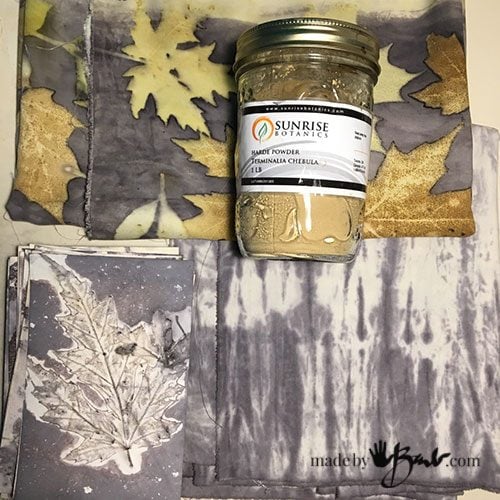
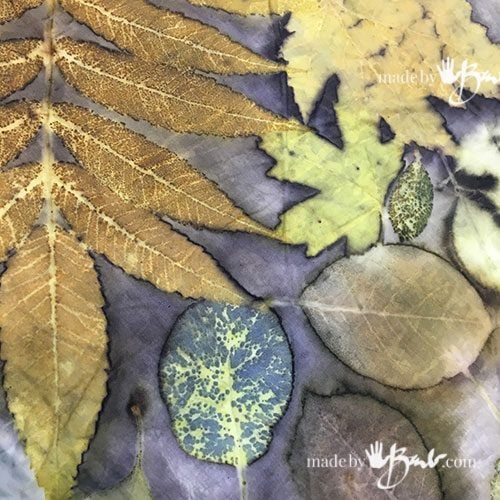
Shown above are some of my favourite dependable printing leaves, iron blanket and a pre-dye of Myrobalan. I bet I know what you are thinking; so what are the recipe amounts? It depends on a few things? What ‘look’ are after? Do you want subtle tones/low contrast? Or do you want very dark background? As you may know; eco printing has many variables such as leaf species, processing times, fibres, water and strength of iron (to name a few). The more you experiment the more you will start to understand the differences you see (this post has comparisons of methods)
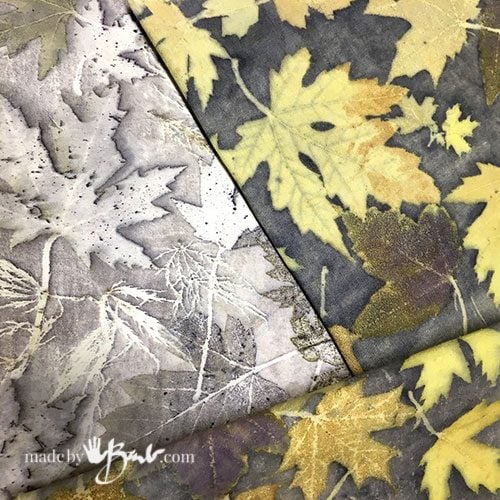
Not sure what method you would like? There are so many ways to use Myrobalan in combination with everything else, especially a rich natural tannin of a certain leaf specie.. I often throw caution to the wind and let it surprise me. Is this not art?!
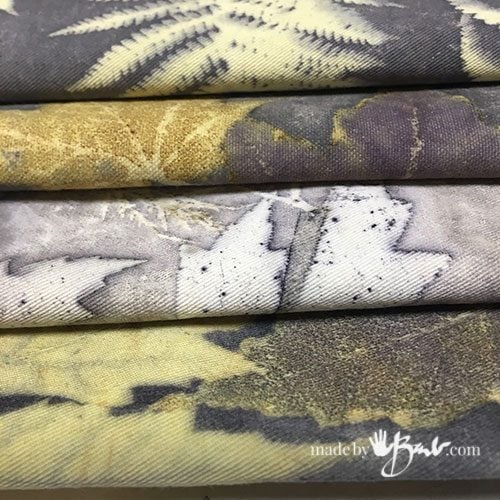
Using the Myrobalan tea (strong to weak) before printing (if a leaf does not have enough tannin) will create a more ‘resist’ stencil type look (top) if using an iron blanket (bottom) or switch it all around backwards (middle) and get a very different detailed effect. (posts coming soon)
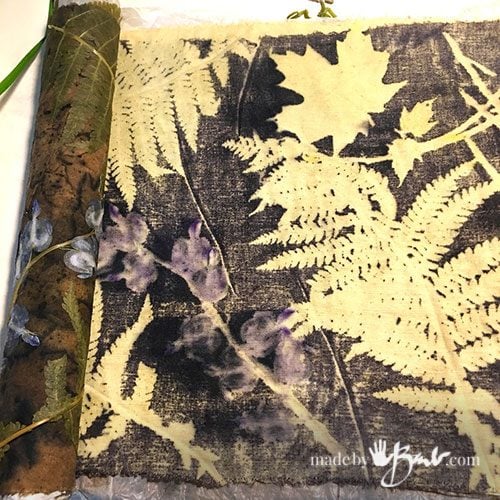
This cotton canvas is pretty heavy weight so the textures are much more pronounced since the thickness of the fibres comes into play. The ferns tend to not have much tannins to print on their own but work well with the Myrobalan to act as a resist for intricacy of shapes. The soft butter yellow use adds a rich design.
So grab yourself some Myrobalan and maybe it can even come in handy for whatever ails you… Happy Printing (watch for future detailed posts)
Great post – I love seeing the different effects achievable. I use Myrobalan mostly with natural dyes, rather than ecoprinting, and had no idea it had medicinal properties too! I’ve been getting it from Maiwa, but see it’s more broadly available. Love your work 🙂
Thanks! I know teas react with iron as well but there’s just something about the blueish tone that I love. Whenever I try something new I get obsessed and want to try it in all kinds of ways. Ah, the artist’s curse! 😉
Great post and thanks at lot! When do You dip the leaves in iron water use the iron blanket too?
No dipping of the leaves, only the iron blanket. Usually you pick one of the methods. Happy printing!
Hi Barb,
I am always amazed by the things you come up with! I inherited some myrobalan but had no idea what it was or what to do with it. Perhaps when I get organised from my recent move and find it I can give it a try.
Thanks so much for all you do to share your ‘secrets’. We your audience are always grateful to you for trying these things out and letting us know your various results.
Carol
I recall how it was like cracking some secret code when I started! I would not call my self an expert at all, but I do have quite a lot of prints by now! Then again, an artist is never really at the stage of perfection! Happy printing!
Thanks for this information Barb.
Are you able to tell me if your jar of miracle mordant is purely this harde powder or if it’s blended?
I’m in Australia and have only been able to locate blends at this stage.
Thanks so much for a wonderful blog and for being so giving with your discoveries!
It is from a place that sells supplies as well as medicinal products. It only states Harde Powder (Terminalia chebula) so I’d expect it to be pure. Well, I guess it’s a trade off since it’s almost impossible for me to find great euca here! When in doubt maybe a test would be worth it!
🙂 Thanks for your reply Barb. I’ll keep an eye out for it here. Since I posted my comment I’ve located some of the pure online for a reasonable price. So I’m looking forward to having a play when it gets here. It’ll be great if this is the magic potion for dyeing cellulose fibres.
Yes, I must admit that eucys abound just outside my door! There’s loads of varieties that survive the snow if you’re in a position to grow your own.
🙂 Thanks for your reply Barb. I’ll keep an eye out for it locally. Since I posted my comment I’ve located some of the pure online for a reasonable price. So I’m looking forward to having a play when it gets here. It’ll be great if this is the magic potion for dyeing cellulose fibres.
Yes, I must admit that eucys abound just outside my door! There’s loads of varieties that survive the snow if you’re in a position to grow your own.
Sorry, commenting on a months old post. You could also try to source some myrobalan from an Indian grocery store if you have any close by. I have a few in my suburb, so when I saw it had medicinal properties and that Indians like to use it as a tea, I thought I’d try out the local stores. The first one I went into had it available for $3.90 for 300g. I asked the guy working there if it was purely myrobalan and he said it was, so here’s to hoping! Have yet to try it out. Do I need to soy milk pre-treat my cotton, I wonder?
When I got all excited with the myrobalan I printed the linen without a mordant and it has held great. A soy pre-treat may not be a bad idea. Sometimes the artist in me crosses her fingers and just dives in… or be scientific and test first. Thanks for the tip of where to find! Happy printing!
Hi Carol, I just read your message and as I am in Queensland and recently got %100 Terminilia Chebula powder (myrobalan) from Bryon Bay supplier recently I thought I would let you know if you have not found any yet.
Terrific and so inspiring. Do you give classes. Either in dying or in cement work?
Well, It’s a question I get a lot, and it sounds like a nice idea but there is so much legalities and insurances that makes that scary not to mention how much time that would also need. I am constantly running as it is trying to stay on top of things! Maybe once I connect with a venue/school! Keep checking out my posts, I try to be quite thorough!
Mi chiamo Giuliana
Il mio paese è l Italia precisamente Santa Vittoria in Matenano, la regione Marche.
Lei è veramente tanto brava e generosa nel condividere!
È stato bello averla scoperta
Saluti
Giuliana Viozzi
Grazie per le gentili parole! È incredibile poter condividere con tutto il mondo! (Thanks for the kind words! It is quite amazing to be able to share to the whole world!)
Hola, sigo tu trabajo y me encanta mucho los resultados, sigo cada post, y siempre aprendo contigo gracias por los consejos, saludo desde Chile.
I always read your emails; they are full of inspiration. The human mind is amazing. So happy when it finds expression through the creativity of a strong, joyous, generous woman. How hard you work! Mostly, I paint. I have health issues, responsibilities and limited space and not much time to branch out, especially when it involves learning some new scientific process. But working with natural materials like this is becoming increasingly attractive to anyone who wants to protect the environment. It can also provide new sources of income for so many people who, literally, have little to work with except flowers, leaves and rusty nails. I am fortunate to own a computer, right now, and am able to follow your instructions on line (including all those comments from others who report on their own discoveries; it does take a village.). But I may not always have computer access. Many people do not. While knowledge and experience develop over time and learning is never complete (thank God) , it would be helpful to have some current ring binders and room to insert project pages with updated information. (Think Department of Conservation publications.) It wouldn’t require any extra writing. You have, already, prepared clear, concise, easy-to-understand lessons and gathered the comments. Just collate them according to subject matter and date and make them available at a reasonable cost. They could be useful for workshops, public or private schools, senior citizens centers, homeless shelters, boys and girls clubs, anywhere where people can benefit from training in the arts. Updates could be printed at the public library or mailed directly to subscribers. Art is not just a hobby to brighten up a dull afternoon. Many famous artists have spent their lives making both beautiful and practical products that enrich our lives; it is part of being truly “human”. THANKS.
Hello Barb, this is such lovely work. I wonder if you would comment on whether you have used oak nut gall or tannic acid with iron – and if you have, why Myrobalan is preferable to you? I have tried oak nut gall and iron on cotton and get that great grey -blue, but even though I’ve used AA mordant too its just mostly washing out a week later.
Judy
I have not found an easy supply of oak gall so I have no experience with it. I like the myrobalan since it is gives such strong results. I don’t know why it would be washing out, seems odd. I even used the Myrobalan on un-mordanted linen Maybe try a different fabric? Why a week later, not immediately?
Love your art and especially love your blog! You are such an explorer! I just started playing with myrobalan and I can’t wait to see more of what you do with it. Have you tried it yet on vintage linen ( well-scoured 😉)? Thanks!
Do you have a website that goes into more instructional details for dyeing? What’s an iron blanket?
My passions: polymer claying, ceramics, sewing, drawing, painting, crafting, making.
Looks like I need one more!
Thank you
Deb
I have many posts for Eco printing in the section under the ‘Home’ menu. There’s even a post on the ‘Iron Blanket’ . This is a great art form, just beware that it’s sometimes not that easily controlled… but that’s also the magic that can happen! Enjoy!
Hi Barb. Thank you for sharing your experiments. I can’t wait to give it a go. Kindest regards
It is like making a magic art… I love that surprise. Almost like scratching a lottery ticket!
hola! gracias por compartir tus conocimientos! quisera saber si el myrobalan se puede sustituir por otro elemento porque no puedo conseguirlo en argentina….. y a la tela la sumergis en myrobalan ????? graciasss
You can try other sources of tannins like other teas. I have read that green tea will work, but I suggest to try some tests first. Yes, I dipped the fabric in the tea. See also here There are also some other natural finds like pomegranate So many ways to be creative!