
Eco Printing – Nature’s Miracle


It’s pretty obvious that I get a lot of my inspiration from nature. When I discovered there is an art form that gets a helping hand from ‘Mother nature’ I was super excited! Magic happens when leaves and fabric come together under the right circumstances. I have lovingly spent the last few months experimenting. The results are so amazingly beautiful and often unexpected. I liken it to christmas each time I unwrap one.

This post will be a bit of a teaser; an introduction to Eco Printing, as this process can not be explained on one page. Mother nature works her magic so I hope to clear up some of that mystery through this post and future specific ones.
Tannins in Nature
The basic principle of eco printing is that various leaves and plant material (fresh or dried) possess tannins which have the ability to print permanent colour onto fibres in the form of fabric when combined with the proper procedure. Not every leaf will be as successful, as some have much higher tannin content than others. The top side and bottom both may yield different results. Results may vary from zone, time of year and even time of day, as there is so much invisible chemistry happening. It is directly related to the art of dyeing with natural plant material. A few pioneers in this craft; India Flint and Irit Dulman have made wonderful discoveries over many years of experimenting. The process usually involves some form of heat and also some pressure to create a distinct print.
It is that time of year here in Canada when the leaves are shedding so it may be the last chance to collect until spring. I have experimented with my local collection and now have my favourite species to collect and store. But don’t feel limited to these. Silver Maple, Sumac (various varieties), Rose, Japanese Maple, Blackberry, Hedge Maple, Walnut, Dark Horse Weigela, Catalpa, are a few I’ve tried. If you have the luxury to obtain eucalyptus there are species that will print bright oranges and reds.
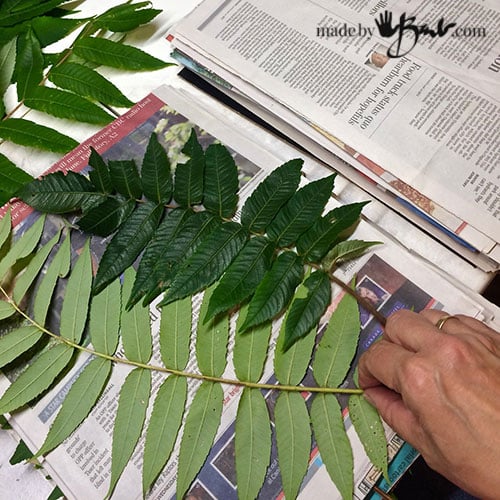
Like a squirrel, I have been stock-piling my leaves for winter. Place leaves in a single layer between multiple sheets of newspaper. I had tried books but they became too full and had more chance of having mold develop since they could not provide enough air circulation. You can stack the piles but do not put too much weight as then they may not breathe adequately.
Sumac is available along roadsides in abundance and maples are quite common here.

Mordants
This process however is not as simple as just plopping some leaves onto fabric. To make the molecules adhere there needs to be a ‘mordant’ that acts like a molecular bond between the fibre and dye of the leaves (plant material). These mordants are commonly metal ‘salts’.
One of the readily available metals is iron. Making a bucket of ‘iron water’ can be as simple as collecting some rusty chain or railway spikes. As when dealing with any chemical; do exercise caution by wearing gloves when working with the solutions.
Other readily available mordant is ‘Alum’ (Aluminum Potassium Sulphate) which is considered safer than many ‘metal salts’ since it is used in the treatment of water and commonly used when making pickles. It can be obtained in the spice aisle of grocery stores.

Some eco printing can be as simple as using a quick dip in some ‘iron water’ to help the leaves’ tannins adhere to the fibre. Since there are chemical reactions happening between so many materials, slight variations bring different results. Once the ‘magic’ happens many artists like to keep it a secret so it may take some personal experimentation to have the entire puzzle to come together.
Historically, dyeing fabric with natural plant material has been around since 100 A.D. Applying heat to a vessel of dye and submerging the textile is simple however the retaining of the colour through time and laundering may not be so easy. Some colours may be wonderful however are called ‘fugitive’ as they disappear over time. To assure colourfastness careful scouring and mordanting is required.

Various Fibres
Results also depend on the type of fibre. Fibres need to be natural, not synthetic. (however I have heard that nylon will print) There are 2 basic categories for fibre; Cellulose and Protein
‘Cellulose’ includes fibres made from plants such as; cotton, linen, ramie, hemp, bamboo, and rayon.
‘Protein’ includes fibres that come from the fur or hair of animals or spun by an insect like the silkworm. Besides the obvious Sheep wool, there is Alpaca, Camel, Angora goats, silk and Cashmere.
Speaking generally, protein fibres do tend to take dye easier and thus yield better eco printing results. Some of the processes include alkalinity and acidity which behave differently with each fibre.
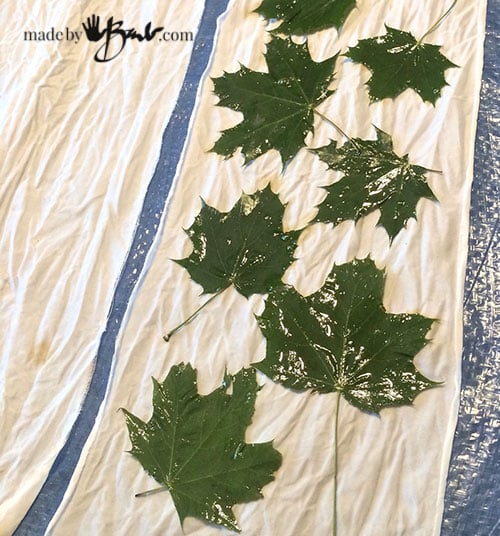
Shown here is one process of laying tannin rich leaves that have been dipped briefly into iron water on damp cotton fabric. The fabric should be first scoured well to clean any residual substance from the fibre. Scouring methods vary according to fibre as well.

To assure a clear print pressure and contact between plant and fabric is also important. There are various ways of layering and folding with rolling being one of the most common methods.

The rolls can be made on pipes, branches or wooden dowels. The material of the centre may also play a key role in the chemistry reaction if made of a metal.

To create good contact and pressure the roll is tied quite tightly with twine. There may also be some other ‘barrier’ material involved to stop colours bleeding through layers.
Sounds complicated?! It really isn’t once the basic principles are understood as then it’s like cooking; so many possibilities!

Heat Processing
Speaking of cooking… The process does involve heat. The rolls may be steamed or even submerged and boiled; each with different results. Experimenting is key, as changing any part of the process often yields different results.

The Reveal
As notes are taken and successes documented, results can still be unexpected. Since it is not visible what is happening until it is unrolled, the anticipation is always exciting. As with anything that is difficult to attain, it is much ore rewarding once you do!

This is one of my first prints that I was quite happy with. The dark results came from a strong use of iron as a mordant.
Results are not always guaranteed so any results are quite welcome and may be used to create unique one of a kind crafts and clothing.

The intricate details that print are quite remarkable and can vary according to the choice of fabric.

As with cooking and baking, combining more ingredients gives more variety of results. Using a dye bath before or after ‘printing’ can give the design a whole new dimension. Prior to eco printing this silk scarf was dyed with indigo dye.
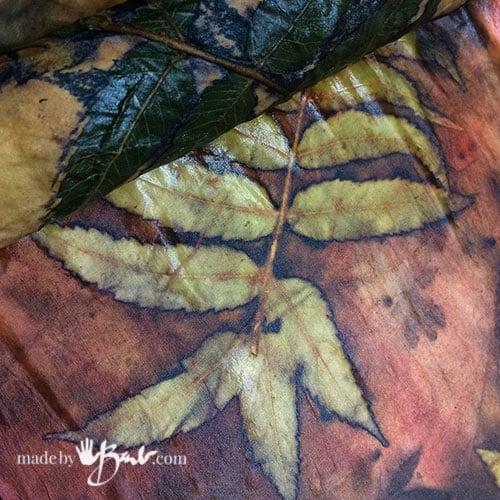
How absolutely amazing is this print on silk?! The red background is from dyeing with madder root, another natural botanical dye.

As an artist, I have spent many years painstakingly hand painting details on landscapes and designs. Eco printing however does not involve that skill but relies on nature’s magic and a bit of know-how. I do not profess to be a complete expert but will share some of my detailed successes.
I do warn you though; it can be quite addicting…
I live in México and want to start making ecoprinting. Your instructions are wonderful. Thank you.
There is so much possibility in this art form. Be prepared to try various tests and you never know what you will achieve! Good Luck!!
I am an acrylic artist but get so excited about new ideas and new ways to create art…I have been experimenting just briefly with paper and Eco Printing…my creative juices are just flowing. We also winter in Mexico where I usually give classes….so I just started experimenting with the paper…thinking simply cards…maybe a journal…and then I start looking on the internet…and I am so hooked…will be trying this in Mexico, with my artsy friends…the fabric sounds fascinating. Thank you for sharing…If I find something exciting my initial reaction is to share with everyone who will listen..not everyone feels that way
I totally understand the excitement of making AND sharing… I guess that’s what I do here. I have many years of being and artist/illustrator as well but love this new art form! Have fun!
I tried exactly the way you have instructed using Iron water and my result was very stunning. I did it on the pure silk fabric, as well on pure soft cotton. They both brought out their unique results. Now I want to experiment few different methods. I live in India, and in my home town the farmers raise silk worm as well spinning and fabric production takes place, so I get the best 100% pure silk I am able to find for a most reasonable price too. Once again Thank You so much.
That is great to hear! You are so fortunate to be able to get such great silk, I am so jealous! I’d love to see what results you got! Glad to help…
Just tried some eco dying and rolled my leaves on a copper pipe and then simmered in a tea bath. The tannin from the tea helped to outline the leaves. Lovely result on a cotton and a sheer silk
Very interesting! Isn’t it fascinating?! That will be just the beginning… Check out the cochineal dyeing and more. Have fun!
Amazing work n explanation
Thank u
Hope to learn more n more from u
Come back often, I’m just about to start printing again as the leaves are just about grown… Wish the day had more hours!
Me encanta tu trabajo eres muy génerosa estoy probando con lo que enseñas así que de a poco voy mejorando y eso es muy bueno, tengo una duda cuando hablan de ecoprint y médium print no se que diferencias tienen aquí en Chile hablan de eso pero es casi imposible que te los aclaren me puedes ayudar con esa duda por favor, y como te decía estoy completamente enamorada de tu trabajo muy agradecida de encontrarlo un abrazo.
Hi Barb,
I’ve been very inspired by your website and am about to start experimenting with eco-printing myself. I wanted to ask you how you scour your silk before you begin making your scarves? I’ve read about many different methods and wasn’t sure how to start and would appreciate your advice.
Thank you again!
Caity
Since I have had such good results I have used no scouring on the silk that I buy. Do you mean mordant? I have mordanted with some diluted vinegar and also not used a mordant at all. Be careful not to use a washing soda (soda ash) on silk as it will damage it. Some dyers use a alum mordant. So much depends on many factors, so sometimes it’s just best to give it a try… Small tests will start to give you something to compare against. But don’t be too sensitive if it does not go perfect, that’s the nature and the pleasure of having a challenge and then succeeding! Let me know how it goes!
Thank you for such comprehensive instructions on ecodying! I’ve been interested in trying this technique of dying but hesitated due to other’s incomplete directions. Now I’m ready to give it a go!
Do you have any tips for dyeing linen? Like mordants? Any advice would be very appreciated.
Your blog is a true wealth of information!
W.
I have only done a small test with linen. But I think it’s much like the cellulose fibres like cotton. You can use some soy milk dips or alum as a mordant. My recommendation: start small with tests of leaves etc. I’ve got some new posts in the works…
Te he descubierto recién y me haz inspirado con tu hermoso trabajo, haces hermosas creaciones con lo que nos entrega la naturaleza….. comenzaré a experimentar y a realizar está maravilla de eco impresión en mis tejidos y telas 👏👏👏👏 eres una artista genial….te seguiré para seguir aprendiendo… gracias 😊
translated:
I discovered you recently and you inspired me with your beautiful work, you make beautiful creations with what nature gives us … I will begin to experience and realize this marvel of eco impression in my fabrics and fabrics 👏👏👏👏 you are a great artist … I will continue to continue learning … thanks 😊
Awe, thanks! It IS wonderful to use nature! And it is so generous to give us so much. Fresh air is good for the soul! Happy making!
Hi Barb,
Do you give instruction in one form or another? I would like to learn this art form., but the information out there seems so spotty and somewhat disjointed. I have seen your work and admire it. I would be interested in learning from you if possible.
Thanks,
Toni Waterman
I understand the frustration… It is the nature of this art form as the factors of the prep and leaves does make for so many different outcomes. I do not do workshops as I have a job as well. I do have a few tutorials under the ‘Home menu’ It took a lot of tries before finally getting some consistent results. For that fact those who have usually sell their info. I’ll have more to post soon as well… Good luck
Thank you for sharing all of your wonderful eco print information. You get amazing results! I am a novice eco printer, and have learned so much from studying your blogs. You mentioned mordanting your silk scarves in vinegar. I’d like to try this, but am wondering how long you soak them, and if you soak them at room temperature, or with heat?
I don’t use heat, just soak for at least an hour. Silk takes printing so well even with out it. I use about a 50% dilution. Learning eco printing is challenging as everyone has a bit of a different way of doing things and all the variables from all over the world make for such varying results. One can not be too literal in my opinion. Embrace your art and enjoy!