
Eco Printing – Nature’s Miracle


It’s pretty obvious that I get a lot of my inspiration from nature. When I discovered there is an art form that gets a helping hand from ‘Mother nature’ I was super excited! Magic happens when leaves and fabric come together under the right circumstances. I have lovingly spent the last few months experimenting. The results are so amazingly beautiful and often unexpected. I liken it to christmas each time I unwrap one.

This post will be a bit of a teaser; an introduction to Eco Printing, as this process can not be explained on one page. Mother nature works her magic so I hope to clear up some of that mystery through this post and future specific ones.
Tannins in Nature
The basic principle of eco printing is that various leaves and plant material (fresh or dried) possess tannins which have the ability to print permanent colour onto fibres in the form of fabric when combined with the proper procedure. Not every leaf will be as successful, as some have much higher tannin content than others. The top side and bottom both may yield different results. Results may vary from zone, time of year and even time of day, as there is so much invisible chemistry happening. It is directly related to the art of dyeing with natural plant material. A few pioneers in this craft; India Flint and Irit Dulman have made wonderful discoveries over many years of experimenting. The process usually involves some form of heat and also some pressure to create a distinct print.
It is that time of year here in Canada when the leaves are shedding so it may be the last chance to collect until spring. I have experimented with my local collection and now have my favourite species to collect and store. But don’t feel limited to these. Silver Maple, Sumac (various varieties), Rose, Japanese Maple, Blackberry, Hedge Maple, Walnut, Dark Horse Weigela, Catalpa, are a few I’ve tried. If you have the luxury to obtain eucalyptus there are species that will print bright oranges and reds.
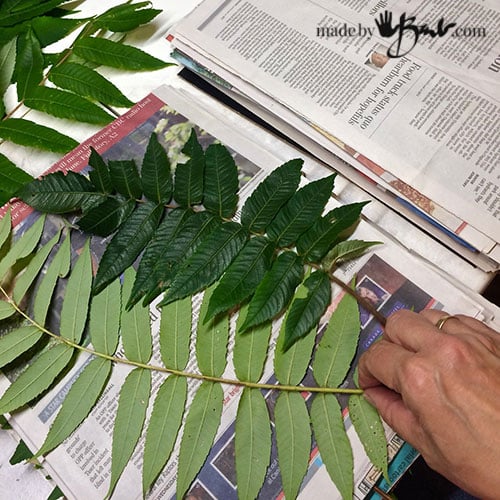
Like a squirrel, I have been stock-piling my leaves for winter. Place leaves in a single layer between multiple sheets of newspaper. I had tried books but they became too full and had more chance of having mold develop since they could not provide enough air circulation. You can stack the piles but do not put too much weight as then they may not breathe adequately.
Sumac is available along roadsides in abundance and maples are quite common here.

Mordants
This process however is not as simple as just plopping some leaves onto fabric. To make the molecules adhere there needs to be a ‘mordant’ that acts like a molecular bond between the fibre and dye of the leaves (plant material). These mordants are commonly metal ‘salts’.
One of the readily available metals is iron. Making a bucket of ‘iron water’ can be as simple as collecting some rusty chain or railway spikes. As when dealing with any chemical; do exercise caution by wearing gloves when working with the solutions.
Other readily available mordant is ‘Alum’ (Aluminum Potassium Sulphate) which is considered safer than many ‘metal salts’ since it is used in the treatment of water and commonly used when making pickles. It can be obtained in the spice aisle of grocery stores.

Some eco printing can be as simple as using a quick dip in some ‘iron water’ to help the leaves’ tannins adhere to the fibre. Since there are chemical reactions happening between so many materials, slight variations bring different results. Once the ‘magic’ happens many artists like to keep it a secret so it may take some personal experimentation to have the entire puzzle to come together.
Historically, dyeing fabric with natural plant material has been around since 100 A.D. Applying heat to a vessel of dye and submerging the textile is simple however the retaining of the colour through time and laundering may not be so easy. Some colours may be wonderful however are called ‘fugitive’ as they disappear over time. To assure colourfastness careful scouring and mordanting is required.

Various Fibres
Results also depend on the type of fibre. Fibres need to be natural, not synthetic. (however I have heard that nylon will print) There are 2 basic categories for fibre; Cellulose and Protein
‘Cellulose’ includes fibres made from plants such as; cotton, linen, ramie, hemp, bamboo, and rayon.
‘Protein’ includes fibres that come from the fur or hair of animals or spun by an insect like the silkworm. Besides the obvious Sheep wool, there is Alpaca, Camel, Angora goats, silk and Cashmere.
Speaking generally, protein fibres do tend to take dye easier and thus yield better eco printing results. Some of the processes include alkalinity and acidity which behave differently with each fibre.
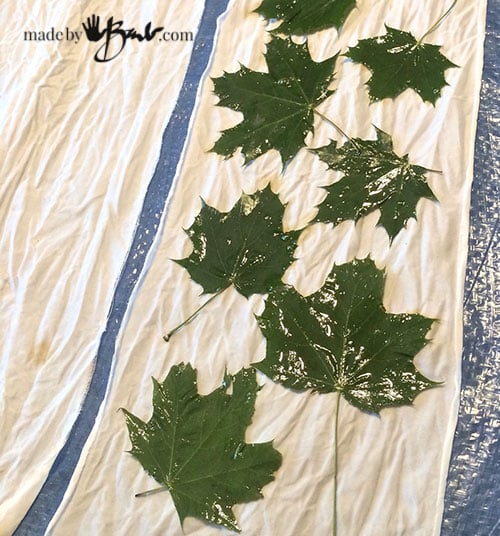
Shown here is one process of laying tannin rich leaves that have been dipped briefly into iron water on damp cotton fabric. The fabric should be first scoured well to clean any residual substance from the fibre. Scouring methods vary according to fibre as well.

To assure a clear print pressure and contact between plant and fabric is also important. There are various ways of layering and folding with rolling being one of the most common methods.

The rolls can be made on pipes, branches or wooden dowels. The material of the centre may also play a key role in the chemistry reaction if made of a metal.

To create good contact and pressure the roll is tied quite tightly with twine. There may also be some other ‘barrier’ material involved to stop colours bleeding through layers.
Sounds complicated?! It really isn’t once the basic principles are understood as then it’s like cooking; so many possibilities!

Heat Processing
Speaking of cooking… The process does involve heat. The rolls may be steamed or even submerged and boiled; each with different results. Experimenting is key, as changing any part of the process often yields different results.

The Reveal
As notes are taken and successes documented, results can still be unexpected. Since it is not visible what is happening until it is unrolled, the anticipation is always exciting. As with anything that is difficult to attain, it is much ore rewarding once you do!

This is one of my first prints that I was quite happy with. The dark results came from a strong use of iron as a mordant.
Results are not always guaranteed so any results are quite welcome and may be used to create unique one of a kind crafts and clothing.

The intricate details that print are quite remarkable and can vary according to the choice of fabric.

As with cooking and baking, combining more ingredients gives more variety of results. Using a dye bath before or after ‘printing’ can give the design a whole new dimension. Prior to eco printing this silk scarf was dyed with indigo dye.
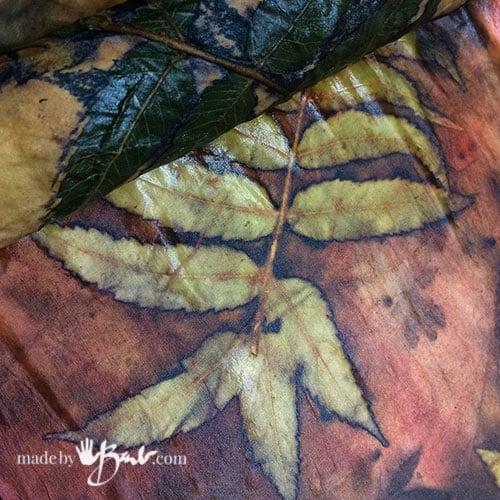
How absolutely amazing is this print on silk?! The red background is from dyeing with madder root, another natural botanical dye.

As an artist, I have spent many years painstakingly hand painting details on landscapes and designs. Eco printing however does not involve that skill but relies on nature’s magic and a bit of know-how. I do not profess to be a complete expert but will share some of my detailed successes.
I do warn you though; it can be quite addicting…
Truly inspiring information and photos!
I think it’s one of the first art medias that I have tried that does NOT give me absolute complete control over the results… maybe that’s what makes it ever so enticing!
Grata por todos os ensinamentos..não sou jovem na idade, mas, adoro a impressão botanica…estou começando,,,,com algumas alegrias e desilusões…mas.não desisto….OBRIGADA pela partilha de SABERES-
“Grateful for all the teachings … I’m not young at age, but, I love the botanic impression … I’m beginning ,,,, with some joys and disappointments … but.don’t give up … .Thank you for sharing KNOWLEDGE-”
Trust me, the nature of this art form means for some (alot) of experimentation. Sometimes the same leaves print differently according to weather. Embrace all your results…. Good luck!
So im in region where there are normal leaves of plants like rose leaves, sunflower leaves ya any other common plant so im was curious about is these leaves will give colour or no? Can u help this with me so I can also experiment this ….Eagerly waiting for your ans
You are in luck! Rose leaves do print nicely! I’m not sure about sunflower. Maybe you have staghorn sumac? It’s abundant along roadways here. Walnut? When in doubt, give it a try! Many of the plants with a redder type of leaf will also colour. I’m testing some soon. There is much info on the web as well. It does depend on a few factors of mordant, fibre and even the condition of the leaf. That’s what has us hooked to keep trying… Embrace any results and keep printing
Thank you for sharing your process. This excites me to try it.
Amazing work.
Thank you
It’s much fun with so many unexpected results. Good luck!
Thanks for your info. it is the best I have found. Now I will get busy experimenting.
Judy
Thanks! It has taken me much effort and supplies to provide free instruction. Courses and workshops are quite expensive and many will keep what they have discovered a secret…
Wow just beautiful Barb. You made the whole process understandable for me. Ive read heaps of articles on dying and usually stop reading half way thru as it loses me 5min in! This was very easy to understand and follow. The word Mordant makes me want to run a mile but u have explained it so simply it actually went into my brain hahaha suprise suprise. Thanks for sharing your wealth of knowledge and all the time and effort u put in to it all. All the hard work done now enables us to ‘ Give it a go’
Great tutorial on all the different fabrics and concrete castings too. Much appreciate u sharing the results of hours of hard work. Cheers Kaz 😆
Kaz: Yes! takes tons of time and effort! Hoping it will be worth it at some point. One thing; I may be using more percentage of my brain. I just love learning and the challenge of figuring things out! The harder it is the more gratifying it is once it works! Happy making!
Oh My! This is freaking AWESOME! Love it and love that you shared it. I hope I can try it within the upcoming year. Thank-you so much.
I’m loving your information, thank you so much for sharing. I’m trying to get my head around a few details, I hope you can help me. I’m scoring my cotton and want to dye it in indigo for the coloured background. Do I also need to soak it in soy milk? Also, I’d like to use the iron blanket to create the shadow around the leaves. Do I also soak the leaves in an iron bath? I’d like it to be as colourful as I can. Many thanks.
You may want to dye the cotton after the printing as the blue may obscure the prints. I suggest that you mordant with soy or tannins or Aluminum Acetate (as I did with the Maple leaf one)
If you soak leaves in iron they will not show as outline. Best thing is to do small test runs… Happy printing!
Love all your posts! How long should you boil or steam the fabric?
Well, I used to boil and steam but lately I have also used the microwave. Steaming/boiling can be anywhere from 1 hour and up. Factors may affect the outcome so it’s best to do some experiments. Obviously using less energy is better…
me puedes decir si has probado con cuero de vaca, qué le colocas encima de las hojas,
y cuanto tiempo lo pones al vapor?
Muchas gracias.
María
So far I have not tried it! But I am starting to research and try. A small test did not work well but it was not cow leather. Often I use an iron blanket as well as a barrier of reused plastic. It all depends on the wanted effect! Key; experiment!