
Eco Printing – Nature’s Miracle


It’s pretty obvious that I get a lot of my inspiration from nature. When I discovered there is an art form that gets a helping hand from ‘Mother nature’ I was super excited! Magic happens when leaves and fabric come together under the right circumstances. I have lovingly spent the last few months experimenting. The results are so amazingly beautiful and often unexpected. I liken it to christmas each time I unwrap one.

This post will be a bit of a teaser; an introduction to Eco Printing, as this process can not be explained on one page. Mother nature works her magic so I hope to clear up some of that mystery through this post and future specific ones.
Tannins in Nature
The basic principle of eco printing is that various leaves and plant material (fresh or dried) possess tannins which have the ability to print permanent colour onto fibres in the form of fabric when combined with the proper procedure. Not every leaf will be as successful, as some have much higher tannin content than others. The top side and bottom both may yield different results. Results may vary from zone, time of year and even time of day, as there is so much invisible chemistry happening. It is directly related to the art of dyeing with natural plant material. A few pioneers in this craft; India Flint and Irit Dulman have made wonderful discoveries over many years of experimenting. The process usually involves some form of heat and also some pressure to create a distinct print.
It is that time of year here in Canada when the leaves are shedding so it may be the last chance to collect until spring. I have experimented with my local collection and now have my favourite species to collect and store. But don’t feel limited to these. Silver Maple, Sumac (various varieties), Rose, Japanese Maple, Blackberry, Hedge Maple, Walnut, Dark Horse Weigela, Catalpa, are a few I’ve tried. If you have the luxury to obtain eucalyptus there are species that will print bright oranges and reds.
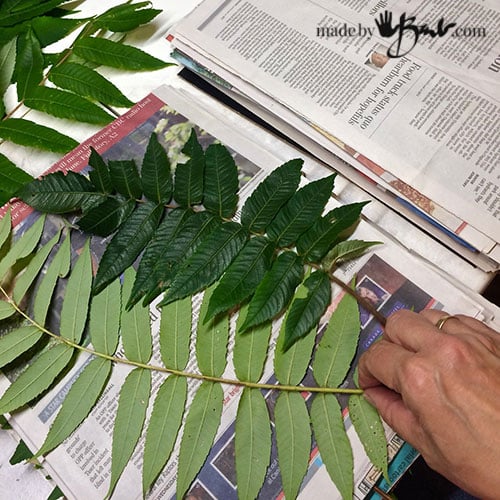
Like a squirrel, I have been stock-piling my leaves for winter. Place leaves in a single layer between multiple sheets of newspaper. I had tried books but they became too full and had more chance of having mold develop since they could not provide enough air circulation. You can stack the piles but do not put too much weight as then they may not breathe adequately.
Sumac is available along roadsides in abundance and maples are quite common here.

Mordants
This process however is not as simple as just plopping some leaves onto fabric. To make the molecules adhere there needs to be a ‘mordant’ that acts like a molecular bond between the fibre and dye of the leaves (plant material). These mordants are commonly metal ‘salts’.
One of the readily available metals is iron. Making a bucket of ‘iron water’ can be as simple as collecting some rusty chain or railway spikes. As when dealing with any chemical; do exercise caution by wearing gloves when working with the solutions.
Other readily available mordant is ‘Alum’ (Aluminum Potassium Sulphate) which is considered safer than many ‘metal salts’ since it is used in the treatment of water and commonly used when making pickles. It can be obtained in the spice aisle of grocery stores.

Some eco printing can be as simple as using a quick dip in some ‘iron water’ to help the leaves’ tannins adhere to the fibre. Since there are chemical reactions happening between so many materials, slight variations bring different results. Once the ‘magic’ happens many artists like to keep it a secret so it may take some personal experimentation to have the entire puzzle to come together.
Historically, dyeing fabric with natural plant material has been around since 100 A.D. Applying heat to a vessel of dye and submerging the textile is simple however the retaining of the colour through time and laundering may not be so easy. Some colours may be wonderful however are called ‘fugitive’ as they disappear over time. To assure colourfastness careful scouring and mordanting is required.

Various Fibres
Results also depend on the type of fibre. Fibres need to be natural, not synthetic. (however I have heard that nylon will print) There are 2 basic categories for fibre; Cellulose and Protein
‘Cellulose’ includes fibres made from plants such as; cotton, linen, ramie, hemp, bamboo, and rayon.
‘Protein’ includes fibres that come from the fur or hair of animals or spun by an insect like the silkworm. Besides the obvious Sheep wool, there is Alpaca, Camel, Angora goats, silk and Cashmere.
Speaking generally, protein fibres do tend to take dye easier and thus yield better eco printing results. Some of the processes include alkalinity and acidity which behave differently with each fibre.
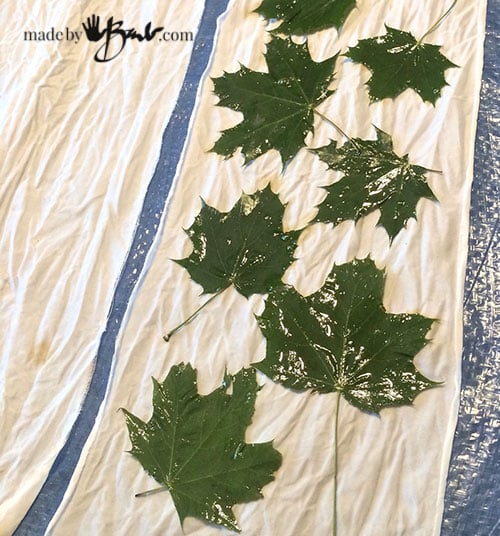
Shown here is one process of laying tannin rich leaves that have been dipped briefly into iron water on damp cotton fabric. The fabric should be first scoured well to clean any residual substance from the fibre. Scouring methods vary according to fibre as well.

To assure a clear print pressure and contact between plant and fabric is also important. There are various ways of layering and folding with rolling being one of the most common methods.

The rolls can be made on pipes, branches or wooden dowels. The material of the centre may also play a key role in the chemistry reaction if made of a metal.

To create good contact and pressure the roll is tied quite tightly with twine. There may also be some other ‘barrier’ material involved to stop colours bleeding through layers.
Sounds complicated?! It really isn’t once the basic principles are understood as then it’s like cooking; so many possibilities!

Heat Processing
Speaking of cooking… The process does involve heat. The rolls may be steamed or even submerged and boiled; each with different results. Experimenting is key, as changing any part of the process often yields different results.

The Reveal
As notes are taken and successes documented, results can still be unexpected. Since it is not visible what is happening until it is unrolled, the anticipation is always exciting. As with anything that is difficult to attain, it is much ore rewarding once you do!

This is one of my first prints that I was quite happy with. The dark results came from a strong use of iron as a mordant.
Results are not always guaranteed so any results are quite welcome and may be used to create unique one of a kind crafts and clothing.

The intricate details that print are quite remarkable and can vary according to the choice of fabric.

As with cooking and baking, combining more ingredients gives more variety of results. Using a dye bath before or after ‘printing’ can give the design a whole new dimension. Prior to eco printing this silk scarf was dyed with indigo dye.
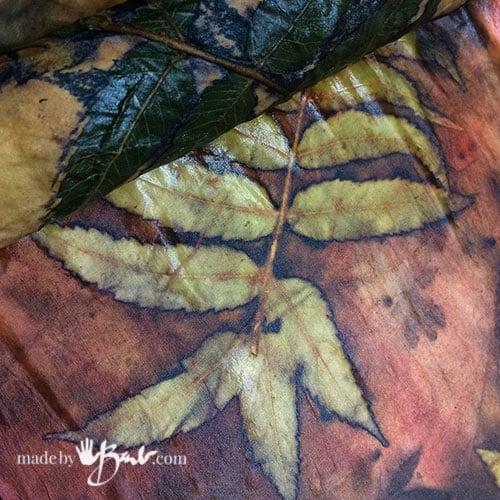
How absolutely amazing is this print on silk?! The red background is from dyeing with madder root, another natural botanical dye.

As an artist, I have spent many years painstakingly hand painting details on landscapes and designs. Eco printing however does not involve that skill but relies on nature’s magic and a bit of know-how. I do not profess to be a complete expert but will share some of my detailed successes.
I do warn you though; it can be quite addicting…
Thank you for sharing your art, you are such an inspiration! What kind of silk do you use for the scarf? I see you get a lot of different types of silk.
I use the silk scarves from Dharma Any other silk is usually from a recycle…
Love this! I’ve read your tutorials a few times and I’m unclear about one step. After laying leaves on fabric and before rolling up I noticed the leaves are covered with a layer which looks like the same fabric that the leaves are on. Is this to stop the leaves moving and bleeding through? Does this result in two pieces of printed fabric? I’ve seen other tutorials where they don’t cover leaves and just roll and wrap.
This was a general post about eco printing so there are a few different methods. Yes there can be another layer of fabric on top (can be an iron blanket) and can also be a barrier to stop any ghost prints through the layers. There is also some info here when printing with the maple leaves. There is a whole section for Eco Printing under the ‘Home’ menu. I suggest using proper mordanting for your specific fibre. So much to learn and experiment! Good luck
Hi Barb,
I wanted to ask a simple question about the leaves that you collect. You mentioned that you had collected leaves and put them between newspaper. Are you doing this so you will have material to use for winter time printing when leaves are not available to you? Do they print as well as fresh and do you have to soak them beforehand so they soften up and would you just use water or something else? Just curious as I live in Michigan and will be taking a class on eco printing this August. I just want to be prepared for the winter time if I decide to do this during that period. Thanks for all the great information that you so kindly share and for answering my questions. I am looking forward to trying this. It’s so beautiful!
Yes, I like to have a stock pile and the fall ones are great to add in to the mix. Here is a post, but do realize that some are more fleshy and will need checking for mildew. Too tight also does not allow drying… I rehydrate with some hot to touch water (maybe a bit of vinegar) and then blot them before use. Happy printing!
Thanks for sharing your experiences eco printing. Just imagine what life would be like if no one ever “shared” how to do something! I’m ready to dive in. I was stuck on the steps in this process , but after reading and reading and reading some more, you finally made it clear. Thank You!
The more I read and read and experiment and watch others I start to see everyone has their own way and it’s not necessarily wrong or right. I don’t know if one can be an expert as there are so many variables that can mess up an expected result; so I’ve just embraced this and treat it like art. Sometimes it’s – WOW and sometimes it’s ok, I’ll make a change next time. It keeps us interested this way. Happy making!
Thank you. Your blog is very informative. I have to retire now and thought eco printing would be ideal to keep me occupied.
Oh it surely will! It’s so magical yet illusive sometimes, it will keep you interested!
Your posting is the first I have heard of eco printing … I can’t wait to try it but it’s January in North America. DRAT! Your creations are beautiful and I thank you for your post!
It’s a highly secretive art form… shhh! Don’t be discouraged by any not so great results; it’s magic when you ‘crack the code’! Enjoy!
Barb, You are an inspiration! Great work all -around. Thank you for sharing your methods.
Surely you have a very big heart ❤that gives us your experience for free💋 I wish you happiness💚, health💓 and longevity from God Your🙏 art is unique🍀🌿☘🍂🍁🌱🌹🤩 I am from Iran, I kiss your artist hands from a distance😘
Oh that is sweet of you! Maybe some da I will have an eBook for sale! Thanks for your blessings!
Hi Barbs, thank you so much for this, I am amazed!!! Your scarves are so beautiful! I am intrigued by the scarf you dyed in indigo, was this done before printing? I would love to see how this works, that the leaves don’t take that colour on. Fascinating… would be grateful for any more info. I have looked indigo up and it seems to be a bit complicated but I would still love to try it.
Ah yes, Indigo! I played with a few ‘vats’ a while back. Even my plastic laundry sink was blue! It is great when it’s new but is a bit of a challenge to keep happy. I think I tried the indigo on the scarves before and after. The after is much more interesting as the indigo chooses where it will adhere. As I see it, there is much effect from the PH of each making the results. Seems being an artist isn’t enough… so much science! It is on my to-do list!
Thank you, Barb, sounds tricky! Maybe I will start with logwood and get some experience with that first. How fascinating! Artist here too! 😀
Thank you again for your generosity, sharing your knowledge with us! Just about to do my first ever print to test various leaves, exciting! I think my family thinks I have gone nuts collecting these leaves…
Thank you, Barb, sounds tricky! Maybe I will start with logwood and get some experience with that first. How fascinating! Artist here too! 😀
Thank you again for your generosity, sharing your knowledge with us! Just about to do my first ever print to test various leaves, exciting! I think my family thinks I have gone nuts collecting these leaves…