
Fitted Face Mask Pattern for Glasses

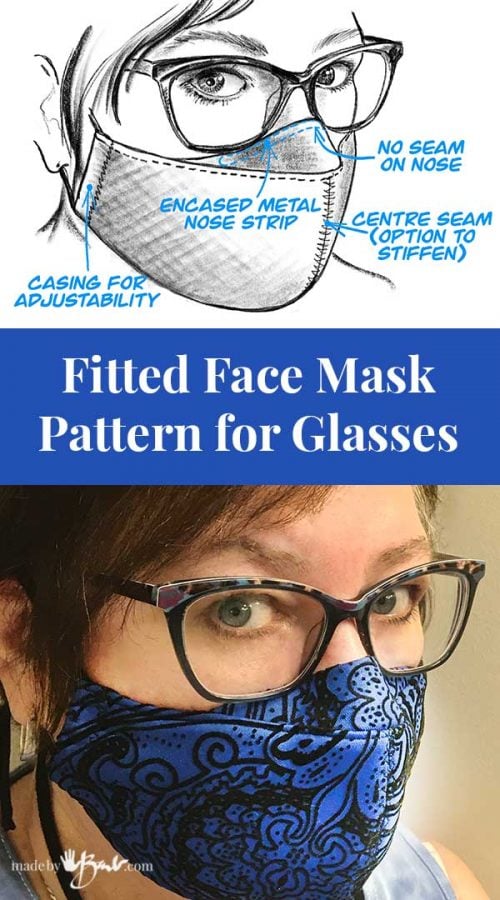
Design should always be about necessity! ‘And that is my purpose here; to fill a need for so many frustrated people who wear glasses and want a good mask pattern. My Fitted Face Mask Pattern for Glasses comes to the rescue…
The Unique Nose Piece:
Oh dear! I am appalled at the way people wear their masks, so each shopping trip is like research. I’m seeing commercial ones but have still not seen that many that look like they are really comfortable or fit well. Maybe that is why there are so many ‘un-masked’ rebels! Fogging glasses and touching mouth are very common complaints.
I know the ‘Olsen style’ mask is very popular and my first design has had great reviews and mass amounts of downloads. The problem would arise when there was just too many layers at the centre seam and that would push glasses up or out, which would affect visibility. To remedy that I removed the centre seam AND the top edge seam to make a single piece for the nose in this fitted mask pattern for glasses. Also, even better; it has a super flat aluminum nose piece ironed inside to make it super flat and adjustable!
To make this Mask:
Download & Print the Pattern. Cut one nose piece, 2 lining and 2 outer pieces. (you can add layers/filter pocket as you like) Fold and press the nose piece in half.
You can also watch it in video form: (please subscribe, so that I will continue making videos)
Make you own Metal Nose Pieces:
Check out my video & instructions to see how to make these nose pieces. Trust me, it’s easy.
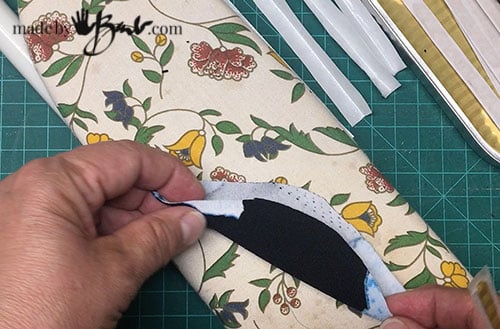
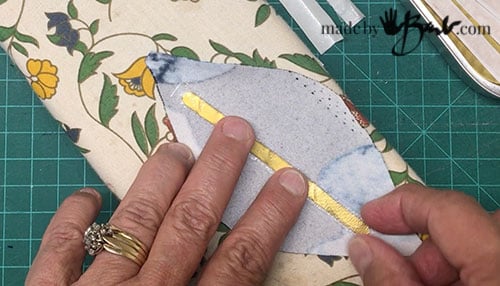
They are made with fusible web so they can now be ironed into place and stay there. Place it next to the centre fold.
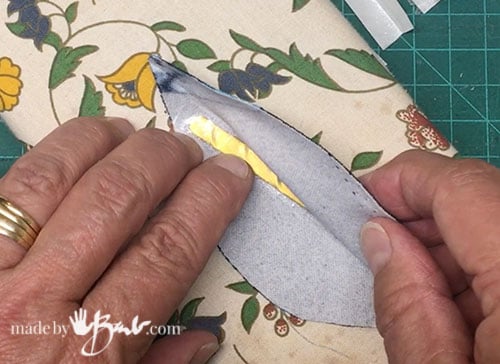
Fold over the fabric and make sure the metal piece stays centred. It should be at least 3/8″ away from edge.
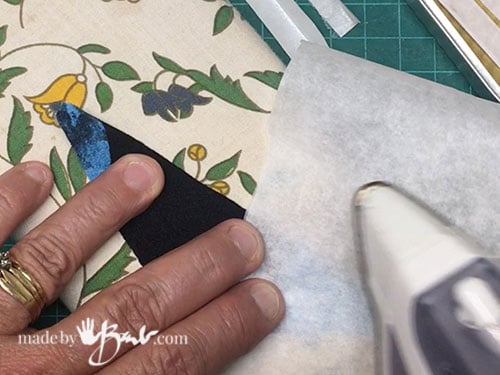
Use some parchment paper to protect the iron from any possible contact with the fusible webbing. (don’t ask me how I know that!)
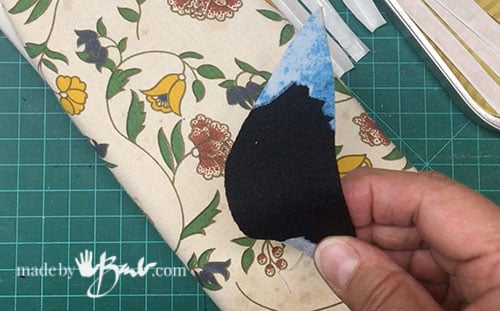
Ta-da! You now have a ready to use nose piece. It is bendable and very slim. Yes it is only 2 layers but if you desire you could do more and use more fusible webbing as well.
I have found that breathability is making the decisions for mask fabric choices… but that’s a whole other discussion. Do make your own decisions.
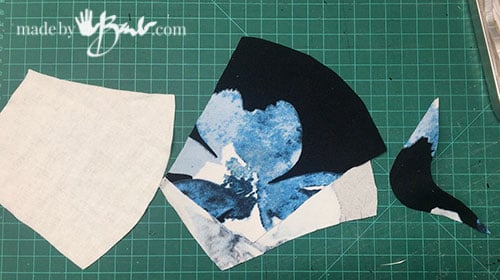
Cut 2 of lining and 2 of the outside fabric. I have decided on a polyester knit here.
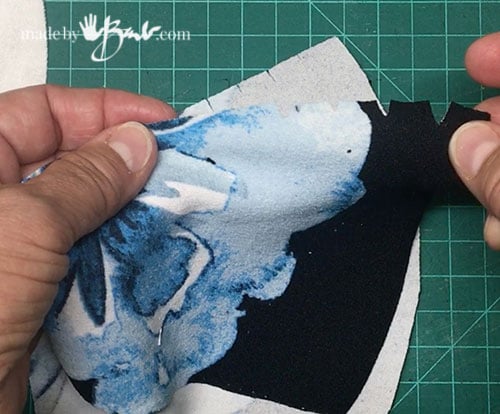
Since the nose piece is not flat, clip at the markings on the top edge.
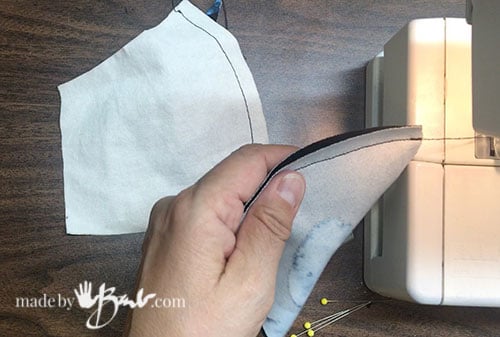
Sew the front centre 3/8″ seams of both the lining and outer fabric

Fold open the centre seam and flatten with top stitching (zigzag or mending zigzag work well)
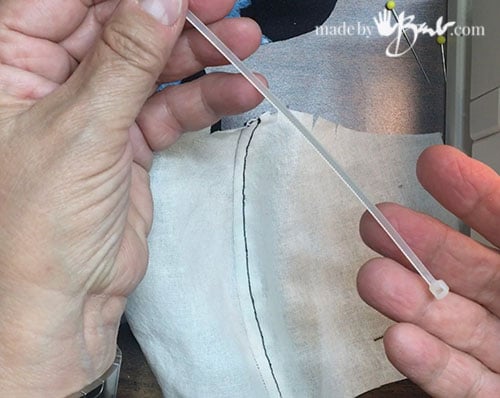
Top stitch a line slightly over from the centre seam and there is the opportunity to put a stiffener in this channel. Zip-ties or pipe cleaners work well and prevent the mask from collapsing at each breath.

Centre the nose piece on the top seam (right sides together) and sew seam, spreading at clips to flatten nicely.
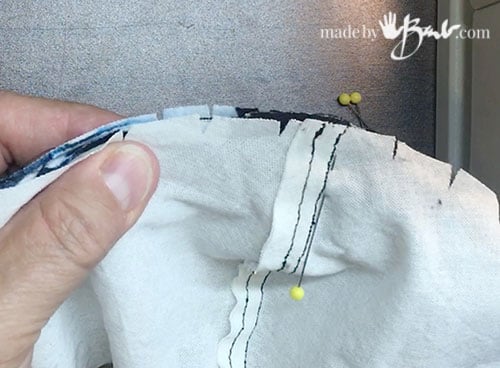
Repeat by adding the lining piece and sewing seam.
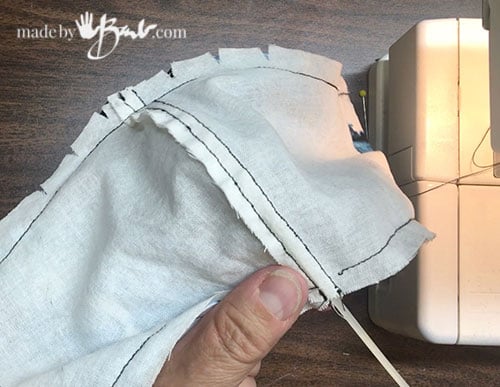
Insert Optional Stiffener:
Push the zip-tie (or pipe cleaner) into the channel and cut at appropriate length and stitch closed. This will help keep the mask off your face. I do not particularly like having something touch my lips, just saying.
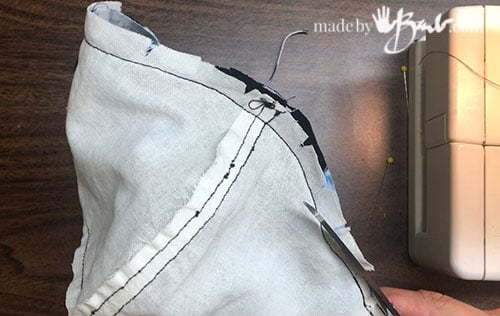
Trim excess seam allowance to make as flat as possible.
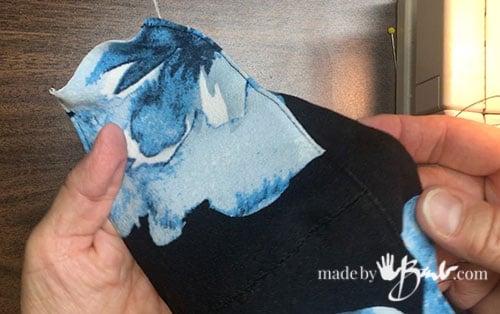
Right Sides Out- Fitted Mask for Glasses:
Turn right sides out (ends are still open) and top stitch close to edge to keep flat and in place.
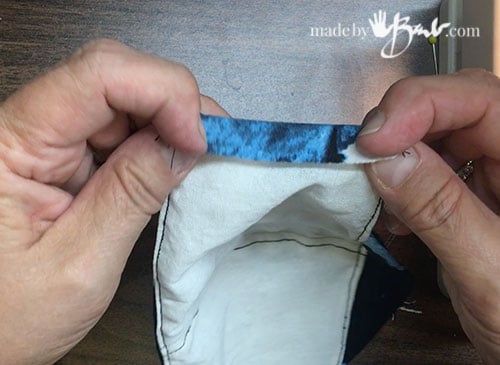
Fold over ends to make casings for the straps.
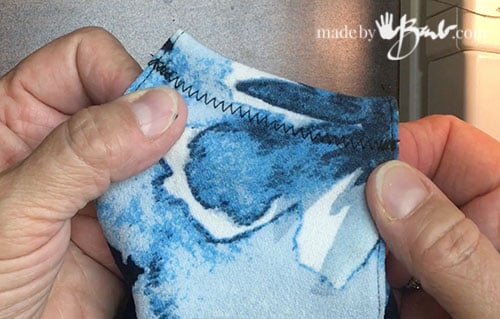
Zigzag or straight stitch depending on how much the fabric frays. I prefer to use some cut strips of spandex-mix t-shirt (like camisoles) to make soft easy-stretch straps/ties. They can be looped around as one long tie or just behind the ears. This is better than permanent elastic.
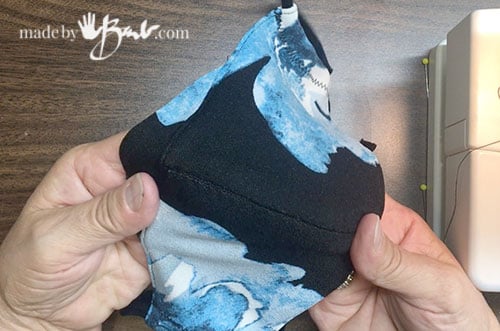
Extra Stability:
Another thing that makes for a better fit of this Fitted Mask for Glasses is that all the layers stay together. I know, you do not want to stitch and makes holes through the fabric, but it can really help keep it more comfortable, off the face so that makes breathing easier since it allows more surface area to bring in air. (You decide) I like to stitch through the layers to keep the lining stable. You can stitch through the front centre and/or across the width.
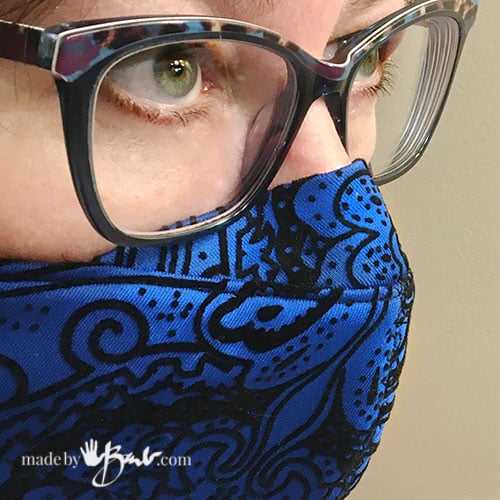

The nose piece set in this way allows for better angle and is much less bulk than having a top seam. Keeping as much stability at the front seam also makes it less likely to keep suctioning to the face.
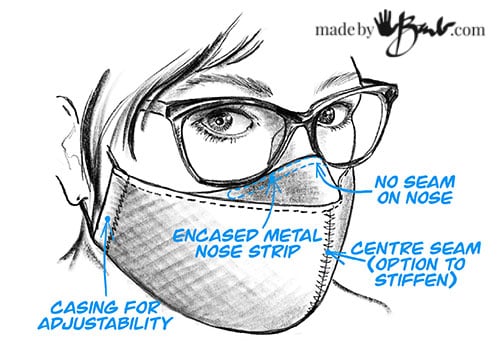
I know I have the other styles like The Ultimate Face Mask & The DIY N95 Style face mask but they also have edge seams at the nose or do not ‘scoop’ lower over the cheek. Small differences in this Fitted Mask for Glasses can mean a lot… (think about the fit of your pants – we all have a favourite)
Whatever you do, please keep yourselves and loved ones safe. We do ths for ourselves AND others!
How much fabric would you say this mask uses? I have not seen in a long time. I’m curious how much fabric it takes to make a mask. I want to try making this one.
I’d measure the narrow part across the mask as fabric usually comes much wider than needed here. I use many of my remnants. Also, maybe some purging has some clothing that can be up-cycled!
Do you sell your mask by chance?
Sorry, I just can’t manage more on my plate at the time. I also teach at a college.
I do not really understand what to do with the nose piece after it is made… do I sew it to the main fabric piece and then flip it up and then sew on the lining? Thank you so much and I do love this pattern. I myself do not wear glasses but have not been able to find a pattern that perfectly forms to my nose.
The nose piece is sandwiched between the outer and lining layers. I sew the nose piece to the outside layer first, then the lining. The outer and lining should be right sides together with nose piece between. Hope that helps!
Tout d’abord un grand merci pour le partage de tous vos tutos incroyablement expliqués, ainsi que pour votre gentillesse à répondre à tous les commentaires. J’aimerai me faire ce masque très bien conçu pour les lunettes mais je n’arrive pas à avoir le patron pdf. Pourriez-vous me l’envoyer par mail s’il vous plaît. Pensez vous que je puisse le coudre dans une soie naturelle ( pongé pour la doublure ,et soie sauvage ou bourrette de soie) Est ce trop fragile ? Puis je le personnaliser avec des colorants à l’aniline ? Ou seulement avec des colorants naturels , et ce, au point de vue des risques pour la santé ? Merci beaucoup. Bonne continuation !.
Your mask pattern was so good that I made a contribution to you as thanks. Grateful that you put the work into creating such a great pattern and even more grateful that you sent it out into the world.
Just went to Microsoft Edge Browser instead of Chrome and was able to download pattern without a problem. Funny how Browsers work 🙂
Yes, there is so much behind the scenes things going on!
Have you found a way to adapt this pattern to accommodate a filter? It looks like a great pattern but I prefer the additional protection of a filter. Do you think extending the lining enough to create a fold-over finished edge at the side before assembling the mask, and extending the casing area a bit so it could be folded to meet, but not overlap, the lining, might work?
Yes, I would leave a side opening to slide the filter in.
Hi Barbara- I love this pattern for the face masks to wear with glasses! How long would you make an elastic to form a loop to be worn around the ear? Would you swe the ends together or tie them? Thanks again!
I lately prefer the straps made with some soft t-shirting (with spandex even better) and then tie or use a pony bead as a toggle. Very soft on the ears!
Instead of zip ties I use boning in the front of the mask and that works wonderfully. Yours is the first mask that keeps it away from my mouth so I can breath and speak easily as well as keeping my glasses fog free!
I’m so happy! Awesome! I have never actually used the real boning, thanks for the tip.
first of all thank you so much for this pattern. I love mine and I’d love to make one for my husband. Do you know if there would be an easy way to adjust the pattern or how I could possibly go about figuring this out? Any advice would be greatly appreciated. 😊
I’d measure his face and figure out what size it should be. Divide the desired size (whatever units you use) by the current size = __% (should be over 100%) to make it larger. The same would work for making smaller but opposite equation. Happy making!
I’m gonna give it a try. Thanks so much! 😊