
Fabric Tests for Concrete Draping


Halloween brings out all the spooks, ghouls and witches! So you need to know how to work with concrete fabric draping; it’s an essential concrete skill. So many choices… so many results. I’ve done a few Fabric Tests for Concrete Draping so you can get to making in time for Halloween!

The Magic in the Mix:
Portland cement is my ingredient of choice. I know many do add other things like sand but I like the way this simple mix behaves. I tend to learn from doing and testing. My ghoul/spook has sat out on a stump through much weather here in Canada, super cold, wind and even crazy heat. He’s been quite smothered in snow and has lasted without any deterioration for over 2 years, so this year there is a surprise addition to his family!

When mixing up the slurry to dip your fabric/fibre in it needs to be thin enough to get into the fibres. That is why I do not use a sand mix as I would find the sand would just end up accumulating in the bottom of the bucket since it had a hard time getting into the fabric.

I will however add some additive many times; just a small ‘squirt’ of acrylic paint. It doesn’t really add much if any colour but does change the consistency slightly and is believed to add strength. It seems to immediately add some thickening to the slurry.
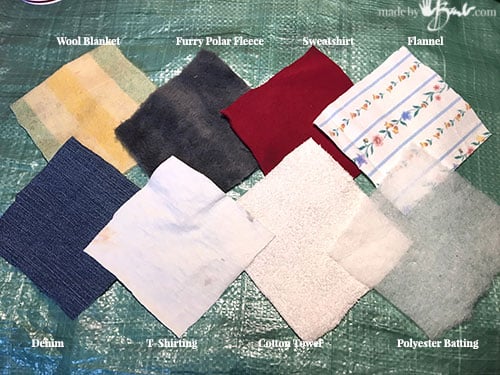
The Fabric Tested:
Since I do a lot of sewing I have a variety of fabrics. Here I have tested typical readily available ones; (upper left to right) Wool Blanket, Fuzzy polyester polar fleece, poly-cotton sweatshirt, cotton flannel, Denim, Cotton T-shirting, Cotton Towel and thin Polyester Quilt Batting.
Make sure to dampen your fabric before dipping as then it will not ‘steal’ the moisture from the cement mix.
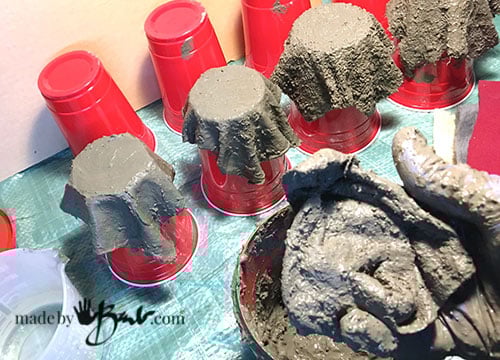
Muck Time:
Make sure to fully incorporate the ‘slurry’ into the fabric. Knead and turn and squeeze until you can see it ooze in/out of the fabric; that is very important. Yes, it gets a bit messy so cover the work area, but then again so is making a pie… Be aware that once the fabric is dipped it will gain a lot of weight so be prepared with your vessel or armature so that it will support the weight.
(Tip: Since I did this indoors I had a bucket of water to dip my hands into to avoid any concrete into the sink.)

All dipped and ready to cure. If it is very hot or dry mist with water to slow the drying and make the concrete stronger.

As it cures the thicker mixes are taking more time and thus look darker.

The Results:
Since some of the fabrics have a tighter weave they will have less ability to absorb the portland cement and thus end up quite thin. They have set nicely but feel fragile and easily broken or squished.

To remedy that you can add more layers of the Portland cement slurry to reinforce and add thickness. You can also do this to smooth any unwanted texture.
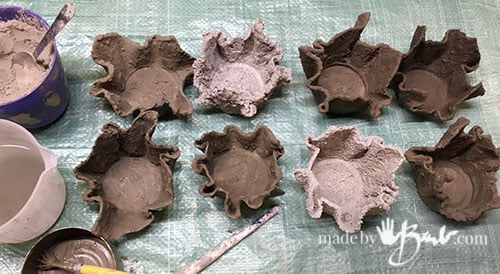
I decided to add a layer to all the tests except the towel and the polar fleece. They were quite strong all by themselves!
The Final Observations:
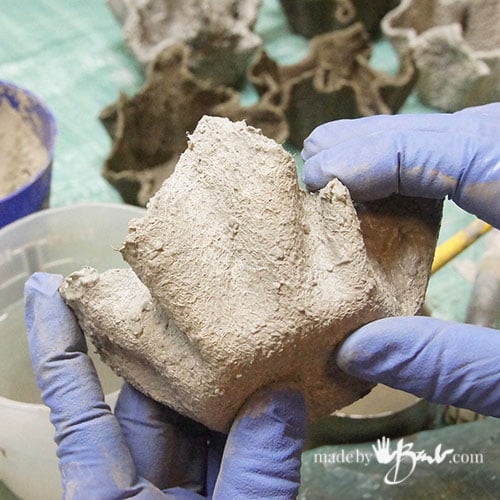
The Wool Blanket:
I was somewhat surprised at how the blanket did absorb the cement. It was a vintage blanket so it was quite thick and thus less able to get into folds and drape nicely. It will hold up quite well though and be fairly smooth. I do wonder though if the since it is a natural fibre it would eventually breakdown inside the cement thus losing some of it’s reinforcing properties.

The Polar Fleece:
This looks quite lumpy and thick since it does get a lot of mix into the fibres. It is great to look like a fur or you can smooth it with a brush just after dipping. (as I did with the spook) It was the strongest of all the tests though due to sheer amount of cement. Since it is polar fleece it is 100% polyester meaning it will take a long long time to breakdown so it will lend it’s reinforcing properties for a long time!
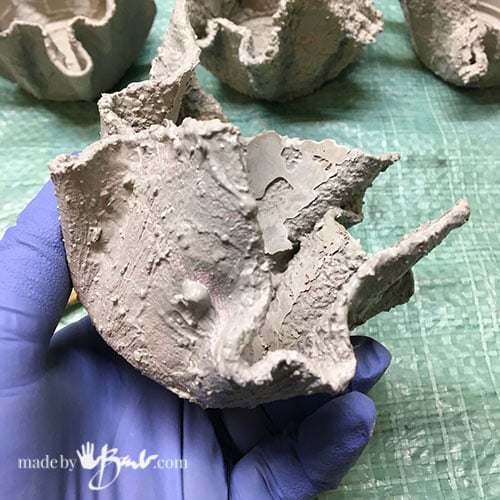
The Sweatshirt Fabric:
This fabric absorbed a medium amount of cement, and could be textured depending on which side of the fabric outward. I did feel it needed extra reinforcement though just as a precaution. It does allow smaller details and folding than the thicker fabrics.

The Flannel:
Flannel has some fuzziness that will hold the mix but really not enough to leave as is. It could however work nicely if you have many folds and layers as that would give it strength. It was one thickness so it definitely needed extra coatings. The lumps were from some of the bits that were in the portland cement. I later put it through a sieve to get rid of them (like flour sifting). The witch was made with a velour fabric which is fuzzier than flannel and it worked quite well.

The Denim:
This denim was one of the thinner types of this day and probably had some slight polyester content in it. Being a tight weave it was very thin and fragile. Since it is a weave and does not stretch it will not drape as well as a knit which gives it limitations. Being quite smooth it shows the brush marks thus making it not one of my first choices.

The T-Shirting:
Cotton tends to absorb a lot so this did as well however it is still limited to it’s thin thickness. It does drape quite well and could benefit from much layering and folds but at a single thickness would need many extra coatings.

The Cotton Towel:
As you see this is really nubbly from the towel textures. Obviously a towel is made to absorb so it does quite well and has good strength. Like the fleece it will however have texture unless it is filled/brushed with more mix. It can drape quite well since it was an old well worn towel.

The Quilt Batting:
I had just come across this and thought it may surprise me. Since it has a fairly large open fibre it does grab a lot of mix but the excess texture does not show that well. It also tends to look ‘hairy’ from the fibres. It was fairly strong but did not give a good edge so it would have limited applications.
Go Make Some:
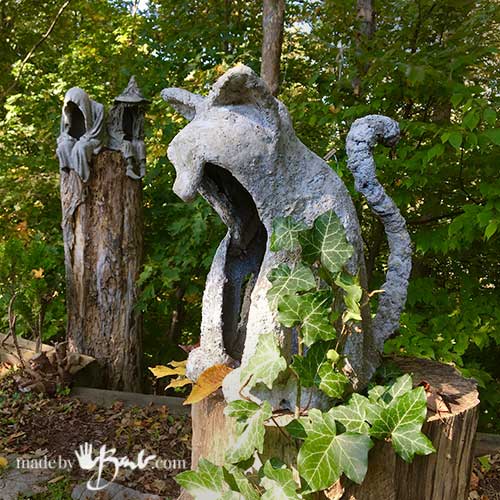
Now that you have an understanding of how easy it is who knows what you can make?!
I will be having a new addition to my family; to my concrete family that is! I have a new ebook for download to make this sweet Cat… Just in time for Halloween.
Happy Concreting!
Love these Barb!! Have never seen a witch or cat done in this technique. My Mom would go crazy for that cat😍! You are filled with such great ideas and I am very appreciative that you share your knowledge and techniques with us! Thank you
Sincerely Angie Gunson
Thanks Barb for sharing your insight into the different fabrics and thickness.
I plan on starting to do this in the spring.
I have been watching a gal from Georgia, She uses the sand and paints after drying.
But I like your simpler method. Hope to be able to donate later,
Thanks again.
Another way to add sand would be to add it in the ‘extra’ layer or find a very very fine one. Problem here is getting special ingredients at a small quantity for crafting. Instead of painting you can also add a concrete colour tint. Happy making!
Have you ever done sculptures using chicken wire as the initial structure and then draped fabric dipped in cement? Looking into making a 5 foot sculpture and want to make a cement person or tree for outside. I’m willing to accept any ideas you have!
I have used underlying structures for making but have used plastic bottles etc like my Ghoul. I’m pretty sure the chicken wire would work great as long as you compensate for the weight of the draped concrete by having a good strong under structure. I’m entertaining the idea of making a big hollow waterfall for my pond in a similar way but with old styrofoam inside. Happy concreting!
Hello ive just started my concrete journey and bought a bag of mortar mix
Will that work ?
Well, I tried it once thinking it was pretty well the same and it did not work. Take it back and get a more appropriate mix. Depending what you are making. This may help. A simple way to start is the Concrete bowls which use Sandtopping mix, but if you want to do draping then Portland cement works great. Good luck!
You have been very helpful. I have tried To do these flower pots But I didn’t wet my fabric 1st. Thank you so much for your expertise advice
Barb, thank you for sharing. Trying concrete has been on my list for a couple years. With your generosity I feel more confident to go forward. I live in Ohio so it will next spring before I can try……unless, it’s Ohio, one never knows.
Start with an easy project like the planters or even the stepping stones as they are hard to go wrong. Don’t blame me once you get hooked…
Barb, I am making some cement planters and water garden tubs using different fabrics. I want to stick with manmade fabrics since I think that they would hold up for much longer than natural fabrics especially in Louisiana with the high humidity and heat with have. Acrylic and polyester (felt-like and knit) fabrics like old blankets seem to work well for me. I have also used polyester craft felt fabric. I also want to try using some dryer lint for some of my projects.
I need to try making a cat like yours! Wonderful cement work you do and I am so happy that you share your knowledge here with us all.
Barb, I can not seem to be able to find the post about making the cat. Could you post a link here to it? Thanks.
Thank you so much for sharing your incredible talent in such a detailed, thorough manner with all of us. Just wish I lived closer to you so I could be an apprentice to you! Thanks so much again!
Haha, I hear that a lot… Maybe some day I’ll do some workshops.
Wondered, if using cloth, you would have to use sand in mixture. Mine too goes to the bottom and is useless. Drives me nuts. A very fine sand works pretty good on most projects, but anything larger is just a mess. Thanks for the fabric experiment, it’s very helpful. I myself, love the extra textured ones.
Yes, I have mostly omitted the sand as I found that. I mention that in my posts. The burlap (scare crow) worked surprisingly well considering how it’s not dense at all. So much fun!
I came across your stuff while looking for new ways to use left over concrete from job sites and I have to say, I had no idea this was even a thing, but I will let my customers in on the secret idea from now on!! Very cool!! : )
Your imagination is the only limit… Check the multitude of projects
I saw the cementing on line a while back and keep wondering how it was done. Your step by step instructions were very educational and inspiring. Now I’m more equipped to try.
I live in the Caribbean where there is very hot sun and was wondering if too much sun is not good for them? Should I find a place to allow them to air dry? Thank you
If it’s very hot and they ‘dry’ too fast then mist with water. Concrete loves to be damp and that’s what makes it stronger. It can also be loosely covered to help from drying out too fast as the water needs to do it’s part in the curing. When in doubt I do tiny test runs… Good luck
Hey Barb,
I love your projects! How come you used Portland Cement instead of the Cement-all like you do more often? Would dit have just set up too quickly? I’d like to do a canvas sneaker and dip it in Cement-all, but maybe it’s not a good idea.
I find that the mixes with sand in them tend to leave the sand behind when dipping the fabric. It will depend on the fibers whether the concrete or Portland cement sinks into it. The canvas may absorb the portland cement but I am not sure the rubber parts will adhere that well. If it has a thick enough coating it may be strong enough. Small tests are always good… Good luck
What type of cement do you use and what is the water to cement ratio? Thank you.
As stated in the post it is Portland cement and I mix it to a consistency that is like thick cream. Ratios may differ on climate etc. It’s always good to do a small test run… Good luck!
Hi, I love your work! I know a bit about cement mixtures for building and I wanted to share something with you. Instead of water, you can add 100% Acrylic bonding agent for a very strong and completely waterproof cement that will last a very long time. It will never crack as it will keep the cement slightly flexible. It is what builders are using in fiber cement mixes. For less strength but still much stronger than only cement, you could add latex paint or PVA (Elmers or other white) glue to replace the water. You can add just enough water to it to give it the right consistency. This will make sure that your work lasts a lifetime. Best wishes!
Thanks! I have added the acrylic paint to some of the mixes with good success in the past. I find the bonding agent seems quite thin and expensive for the amount. You are right, for the draping it would be great. I remember adding some paint when I made the Step spook as I was also trying to get some colour. He has lasted well. The other mix; Rapidset Cementall I use does not seem to like the addition though, as it coagulates right away. It is probably because it already has some in it as I find it is quite dense and non porous.
Hello. I’ve been making hypertufa pots, balls, faces, and things for several years. I learned from a retired chemist from a Portland cement company. He tells us that if we keep the object damp, never dry out, for a month it will continue to get stronger. So I put the object in a garbage bag, or the equivalent, checking it every few days and bring it out in a month. And then, if it’s a pot, I have to rinse the pot for a couple of months to get the pH down before I plant in it. Have you done the “keep it wet” with any of your rag items? I’m thinking of making a doily pot.
I know about keeping it wet helps to build strength, even if in water. I’m too impatient to wait a month though. I do soak the pots and change the water to rid of the alkalinity, even add a bit of vinegar. If working outside I do cover if it’s ver hot to slow the drying. I have not kept it wetter than the usual setting time and they have held up quite well. I can see it being a good idea though as being thinner than most applications could use the extra strength. I bet it can’t hurt… ‘Love to hear back on how it works for you. The testing was done in-house so less quick drying…