
Fabric Tests for Concrete Draping


Halloween brings out all the spooks, ghouls and witches! So you need to know how to work with concrete fabric draping; it’s an essential concrete skill. So many choices… so many results. I’ve done a few Fabric Tests for Concrete Draping so you can get to making in time for Halloween!

The Magic in the Mix:
Portland cement is my ingredient of choice. I know many do add other things like sand but I like the way this simple mix behaves. I tend to learn from doing and testing. My ghoul/spook has sat out on a stump through much weather here in Canada, super cold, wind and even crazy heat. He’s been quite smothered in snow and has lasted without any deterioration for over 2 years, so this year there is a surprise addition to his family!

When mixing up the slurry to dip your fabric/fibre in it needs to be thin enough to get into the fibres. That is why I do not use a sand mix as I would find the sand would just end up accumulating in the bottom of the bucket since it had a hard time getting into the fabric.

I will however add some additive many times; just a small ‘squirt’ of acrylic paint. It doesn’t really add much if any colour but does change the consistency slightly and is believed to add strength. It seems to immediately add some thickening to the slurry.
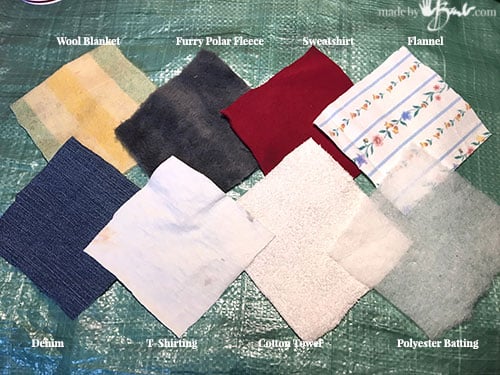
The Fabric Tested:
Since I do a lot of sewing I have a variety of fabrics. Here I have tested typical readily available ones; (upper left to right) Wool Blanket, Fuzzy polyester polar fleece, poly-cotton sweatshirt, cotton flannel, Denim, Cotton T-shirting, Cotton Towel and thin Polyester Quilt Batting.
Make sure to dampen your fabric before dipping as then it will not ‘steal’ the moisture from the cement mix.
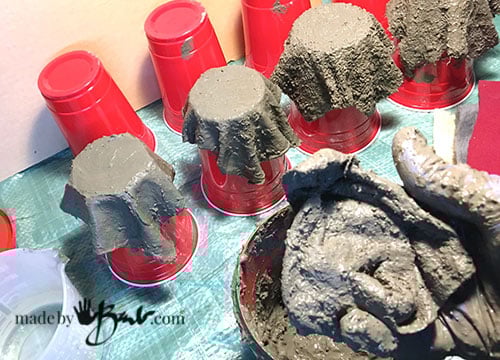
Muck Time:
Make sure to fully incorporate the ‘slurry’ into the fabric. Knead and turn and squeeze until you can see it ooze in/out of the fabric; that is very important. Yes, it gets a bit messy so cover the work area, but then again so is making a pie… Be aware that once the fabric is dipped it will gain a lot of weight so be prepared with your vessel or armature so that it will support the weight.
(Tip: Since I did this indoors I had a bucket of water to dip my hands into to avoid any concrete into the sink.)

All dipped and ready to cure. If it is very hot or dry mist with water to slow the drying and make the concrete stronger.

As it cures the thicker mixes are taking more time and thus look darker.

The Results:
Since some of the fabrics have a tighter weave they will have less ability to absorb the portland cement and thus end up quite thin. They have set nicely but feel fragile and easily broken or squished.

To remedy that you can add more layers of the Portland cement slurry to reinforce and add thickness. You can also do this to smooth any unwanted texture.
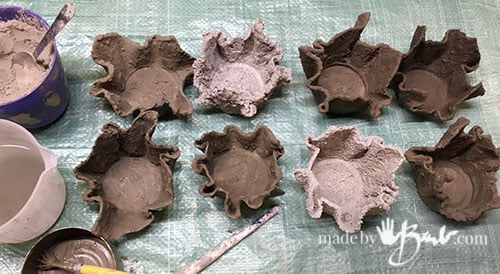
I decided to add a layer to all the tests except the towel and the polar fleece. They were quite strong all by themselves!
The Final Observations:
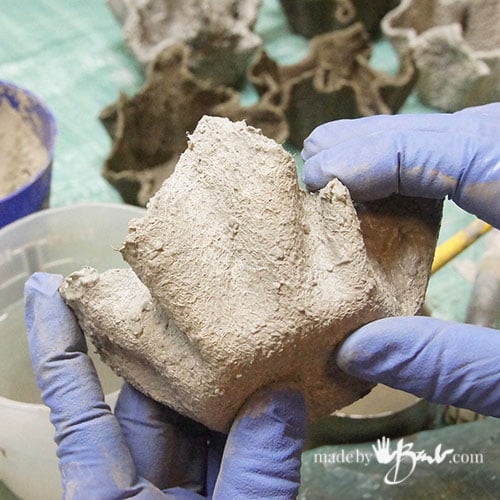
The Wool Blanket:
I was somewhat surprised at how the blanket did absorb the cement. It was a vintage blanket so it was quite thick and thus less able to get into folds and drape nicely. It will hold up quite well though and be fairly smooth. I do wonder though if the since it is a natural fibre it would eventually breakdown inside the cement thus losing some of it’s reinforcing properties.

The Polar Fleece:
This looks quite lumpy and thick since it does get a lot of mix into the fibres. It is great to look like a fur or you can smooth it with a brush just after dipping. (as I did with the spook) It was the strongest of all the tests though due to sheer amount of cement. Since it is polar fleece it is 100% polyester meaning it will take a long long time to breakdown so it will lend it’s reinforcing properties for a long time!
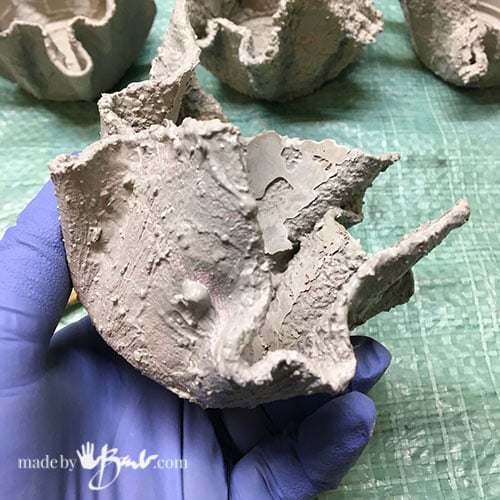
The Sweatshirt Fabric:
This fabric absorbed a medium amount of cement, and could be textured depending on which side of the fabric outward. I did feel it needed extra reinforcement though just as a precaution. It does allow smaller details and folding than the thicker fabrics.

The Flannel:
Flannel has some fuzziness that will hold the mix but really not enough to leave as is. It could however work nicely if you have many folds and layers as that would give it strength. It was one thickness so it definitely needed extra coatings. The lumps were from some of the bits that were in the portland cement. I later put it through a sieve to get rid of them (like flour sifting). The witch was made with a velour fabric which is fuzzier than flannel and it worked quite well.

The Denim:
This denim was one of the thinner types of this day and probably had some slight polyester content in it. Being a tight weave it was very thin and fragile. Since it is a weave and does not stretch it will not drape as well as a knit which gives it limitations. Being quite smooth it shows the brush marks thus making it not one of my first choices.

The T-Shirting:
Cotton tends to absorb a lot so this did as well however it is still limited to it’s thin thickness. It does drape quite well and could benefit from much layering and folds but at a single thickness would need many extra coatings.

The Cotton Towel:
As you see this is really nubbly from the towel textures. Obviously a towel is made to absorb so it does quite well and has good strength. Like the fleece it will however have texture unless it is filled/brushed with more mix. It can drape quite well since it was an old well worn towel.

The Quilt Batting:
I had just come across this and thought it may surprise me. Since it has a fairly large open fibre it does grab a lot of mix but the excess texture does not show that well. It also tends to look ‘hairy’ from the fibres. It was fairly strong but did not give a good edge so it would have limited applications.
Go Make Some:

Now that you have an understanding of how easy it is who knows what you can make?!
I will be having a new addition to my family; to my concrete family that is! I have a new ebook for download to make this sweet Cat… Just in time for Halloween.
Happy Concreting!
the cement I get has so many large pebbles in it. Should I sift it first ??
You may have to depending on what you will be doing. Not all mixes are the same; you may have the typical concrete that is meant for sidewalks etc. I used portland cement for the draping. This post may help you figure out which is best. If you want to cast some bowls the sifted concrete should work for that. Once it is sifted it will be like the sand-topping mix. You may want to do a small test piece before wasting time/materials…. Don’t give up
I am wondering if nylon net curtains could absorb the cement mix as I have yards and yards of it. I would be really grateful if you have experimented with this fabric and maybe come up with a modified recipe for the cement many thanks for sharing your testing it is most useful
Generally I find that if the fabric does not have any good fluffy fibres there’s nothing to ‘grab’ the concrete/cement. Usually that fabric is a really really fine weave. A thought; maybe use it as a outside mesh and fill to make some other forms like the ‘pantyhose gnomes’. There’s always some possibilities once you open your mind… Good luck. You can also use that fabric to make reusable produce bags! I’ve got some ear marked for that
I have been brainstorming a DIY project to divert water through our yard – think mini canal. I wonder if fleece, cut into rectangular panels, dipped in cement, and draped over 2”x 6” boards would work for this purpose. This would create segments of canal that I would set into the ground to direct rain water down the slope of my yard to the back of our lot. What do you think?
I think it is doable. If the first coat is not dense enough you could add another layer. I find that the Rapidset Cementall is a very hard dense concrete and may make a great top layer as I see no seepage of water through it. You may test which fabric works best for you. Also consider some barrier like plastic to keep the concrete from sticking on the wood. Good luck!
Great information, I recently bought a bag of Portland cement and your sharing has been very helpful. I especially like the globes. So I am off to get some fleece.
Thanks again
Deb
Thanks! So many concrete options!
I m Brasilian and plan to make some planters from diferent fabrics
Your post w ll be very helpful.
Thank You.
Yes, there are so many amazing possibilities! Good Luck!
Wow very helpful. I am wanting to do this doily draped birdbath to help camouflage a repaired patched birdbath. Do you think just dipping in the portland cement would be strong enough? This one looks really cool.
https://www.pinterest.com/pin/247627679488634571/?lp=true
Well, as I have found through the draped concrete projects that some fabrics don’t absorb as much of the Portland cement as others. It looks really pretty but also fragile. There is always the option of adding some extra afterward by painting it but that may fill all the doily effects. I would use a small one and do a test run over a container to see. Sand and other materials can be added but they need to adhere somehow. The Rapidset Cementall is a really strong mix but it does have some fine sand (or like) and it’s more difficult to have the fabric take up the concrete. It’s all fun and play!
Thank you for the useful information. So far I’ve tried light fabric such as curtain netting so introducing new textures will be interesting.
Hang on to your jeans and t-shirts family I’m on the hunt.
Many thanks for sharing
My favourite is something with a bit of thickness to absorb. It came in handy for the Faux Bois! Happy draping!
Thanks for sharing this is very helpful. I wonder if you have tried dipping craft foam in cement? If so did the cement adhere to the foam and what was the result?
I’m interested to hear your thoughts if you would consider using foam in a project.
Thank you
Anything that is plastic-like will not adhere to concrete. It would crumble off for sure. My coasters don’t stick to the plastic or the leaves!
What a super fun experiment!! I personally feel like the denim is my favorite look. Very cool! : )
I was surprised how well the burlap worked (Scare crow) I see more draping in my future, not to mention I have a lot of fabric…
I’m planning on using an old crochet lace table cloth to make a planter instead of using an old towel. Is there anything I need to know. For example: do I mix the concrete the same.
I have seen that done and always wondered if it could hold enough of the Portland cement to make it sturdy. Your challenge will be to get it to absorb the portland cement slurry well and also not ‘fill up’ the holes of the lace completely. I would not use any sand in the mix and work it into the fibres well. If it’s ‘soft’ when cured you can add another layer by brush. I’d also mist it with water during cure as concrete likes to slowly cure. Let me know how you make out. My scarecrow turned out amazing even though the burlap is quite open weave. Have fun!