
Carrier Blankets in Eco Printing


It’s sometimes so confusing how all this comes together in Eco Printing and how many different ways that it can be combined. Whaaaat? Yes, I know; let me help you figure it out just a little more using carrier blankets in Eco Printing.

What is a Carrier Blanket?
Do you remember when you were trying to figure out what an iron blanket was!? Well, this is like that but it does not bring the iron this time; it brings another element to the mix. Most often it would bring a natural dye (maybe even another dye) or a tannin to the print fabric. This carrier piece of fabric is not meant to permanently hold whatever it’s adding, but to transfer it. I often like to use an old cotton flannel sheet as the carrier blankets since they are quite absorbent and have already lost their lint.
The carrier blanket should not be mordanted as this would make it ‘keep’ any dye to itself. These carrier blankets can be dipped or soaked in a natural dye and give quite a different effect than the use of the iron blanket.
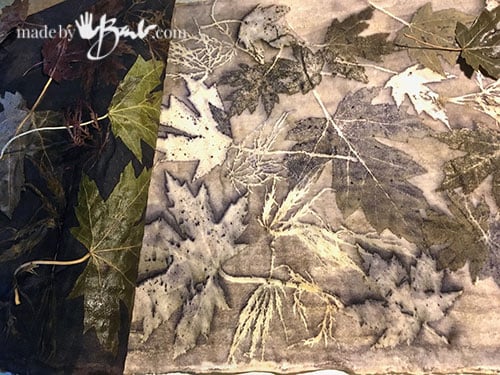
Another way to use the carrier blanket is to soak it in some form of a tannin. The receptive print fabric would then be dipped/soaked in iron. This method was discovered accidentally by Irit Dulman when there was a confusion of solutions in her workshop. It’s great when accidents invent new things!
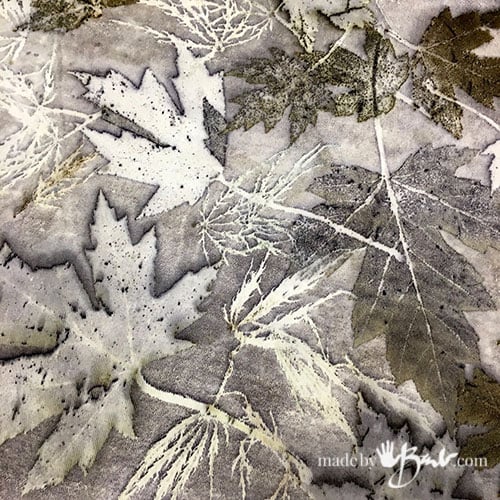
Things to note:
When switching the carrier and the iron application (as above) the leaves will be quite shadowed and silhouetted; any heavy tannin leaf specie will also print dark since the fabric is dipped in iron, which is different than the iron blanket.
Understanding ‘the where’ and ‘the why’ of effects will start to give you a bit more control of what you can expect. At least that’s what we hope…
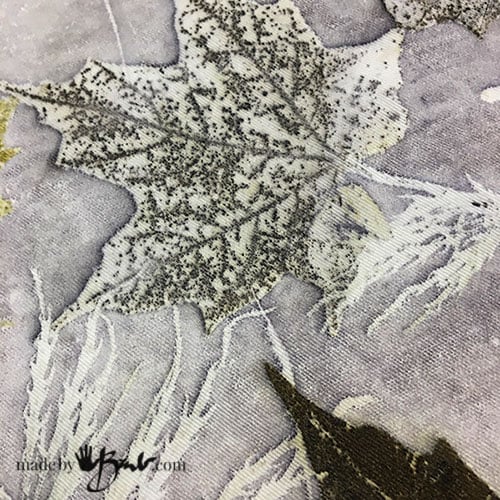
Generally I tend to use the ‘sun side’ down so that details are lighter. But as you probably already know there are times when it just does what it wants.

This silk is dipped in an iron solution (somewhat weak) and then the cotton flannel carrier blanket was a quite concentrated logwood dye.
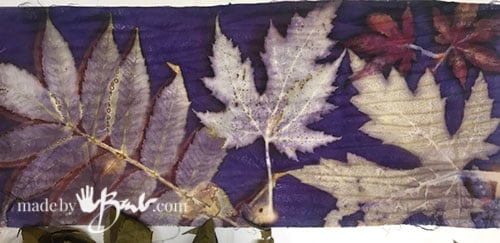
It’s always helpful to see the before and after, to see which sides of leaves were used. The sumac is a very reliable printer so it brought quite a bit of colour.
Imagine how a cochineal or madder blanket could add colour and design?! There’s really no limit, even mixing multiple kinds against each other, something a pre-dye could not do. It’s NOT following rules that gives new interesting results. Give it a go…

Sometimes dyes are deceiving though. When I see the used dye it looks like there is still a fair amount of colour left in it however it can be quite spent; as in the above print. The logwood carrier blanket did not transfer much to the silk at all, thankfully the maples ‘stepped up their game’! I’d say it was a happy accident.
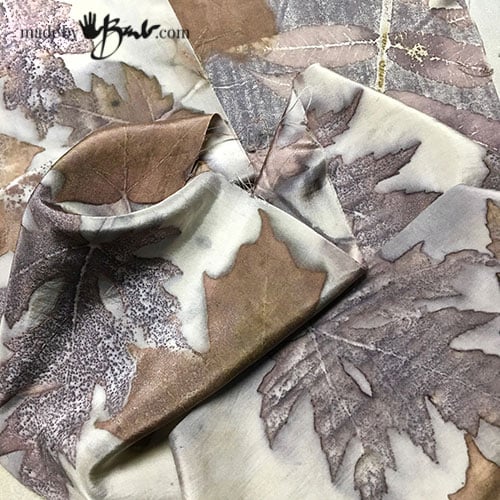
Sometimes the carrier blanket will bring some texture; especially if it a highly iron-reactive one like Myrobalan.
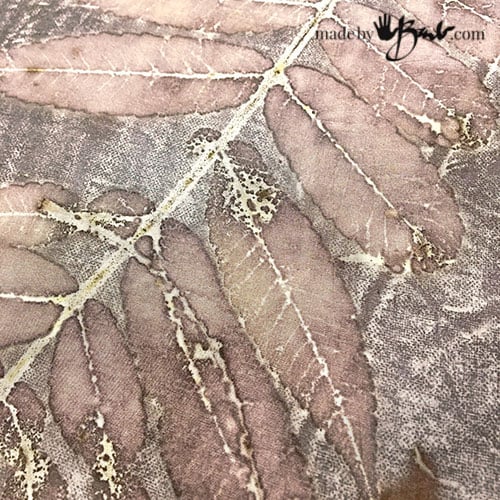
Lovely Eco Print texture:
See how the texture shows through. Yes, some use disposable paper towels and get some interesting texture prints. As with any eco printing the amount of wetness plays key.

Just when you think you have it all figured out there’s more ways to switch it up. Such lovely details and less silhouette shapes in this Myrobalan blanket.
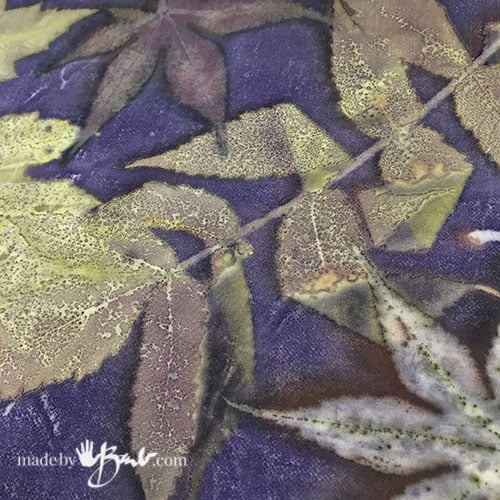
So when designing your desired outcome, there’s more choices. What kind of carrier blanket? What leaves AND what sides to use? I know what you are thinking; how strong to make the solution? Well, again that depends on many things; the absorbency of the blanket, the amount of fabric to print, the overall wetness, the dye type, and the strength of the iron. I tend to use some logical rationale and some luck.
If you are new to eco printing this method helps ensure some recognizable images since even leaves without much tannin can provide a silhouette design.
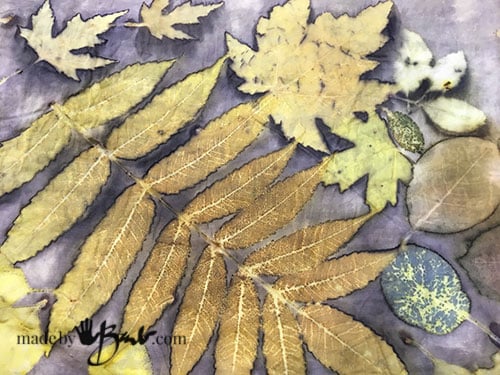
Will every print amaze you?! Probably not! You will probably learn something from each one though. It’s a fun journey and there’s the anticipation of magic that keeps us interested.
I hope you are not under snow, but maybe have a stockpile, and can give this a chance. Remember; it’s a journey, not a destination…
Thanks, Barb, for your clear explanation and great photos!
Hi Barb:
I’m delighted you are flinging back the proverbial curtain on Eco dyeing/printing and sharing heretofore what were considered secrets of the trade. Or at least info that was not readily available. Thank you for that. Do you steam your bundles? Or boil them? And for
How long. You get such great results!
I am a rebel in the eco printing world I think. I use the microwave! I do a few short blasts where it does not get to boiling point and insulate between and after. Some were still warm from my printing yesterday afternoon! Such a saving of energy! Good luck!
It seems that no matter which way to do this printing they all come out so wonderfully deightful in colors and textures. You and nature make a great pair!
I do a lot of printing! Not everyone makes it to ‘post’ status! But it’s fun none the less!
Thanks for making the journey more logical.
Question. Do you mordant the fabric that is receiving the iron? If not how does the color from the carrier blanket permanently adhere?
Hi Barb, A huge thank you for your sharing.. My question is do you presoak the cotton flannel in soya milk beforehand to hold say cochineal or madder . I understand cotton doesnt take colour permanently. Although in saying that I have used cotton as an iron blanket and it certainly uptakes the iron imprint.
No I don’t mordant the carrier cloth as it should let the colour go. I may make sure it’s good and clean though. I’m wondering if using a non-cotton would better ‘pass’ the colour. Hmmm, something to test. Yes, I love some of my iron blankets so much! I like the tones of grey. Happy printing!
Hi Barb,
Thank you for this blog and your tutorials! Have you tried a blanket with titanium oxalate? I’ve started experimenting with this but it is early Spring here in North Central Washington and am waiting for more leaves to emerge!!!
No, I really hate having to buy weird chemicals from mail order. I would rather use what is readily available. I am waiting anxiously as well! And here they say some more snow… Kepp watch I may try it someday!
You are a very generous woman Barb! And I appreciate you.
Thank you for crediting Irit Dulman…I read a blog she wrote where there was
frustration around being credited…this is important in our art/craft world, and
yet we now live in a high tech world where information is at our fingertips…
I myself am a slow living being…and know that there can never be too many artists
and crafters and beauty bringers. And you are exceptional! Long live creativity, wonder
and exploration! You fan the flame!
Eco printing is quite an art! It seems the more it is ‘mixed up’ the more interesting results! I have never taken a course and figured out most just by doing; the best way in my eyes! I am quite the observer which helps! I know how it feels to have content taken without any acknowledgement! It’s a sad world now…
Barb, you do inspire us to be better and to explore many avenues of eco printing! Thank you! My daughter and I and several of our friends have been trying different methods and seeing where this venture takes us. Today I unwrapped my print made with the myrobalan blanket and it just knocked our socks off. By far the most interesting scarf I’ve done, and I’m sure there are many more in the works.
Thank you for the information!
Carolyn
Isn’t it so much fun to open a bundle!!! Myrobalan is an almost fail-safe addition! It actually has some medicinal uses too! Good luck!
Hi barb you are great in ecoprinting.i just want to know how to make tannin blanket.
This post has all the info needed. Whether you soak the ‘Carrier blanket’ in dye or a tannin it will bring that to the combination. When using a carrier blanket, then print fabric is usually dipped in an iron solution. Experiment and have fun!
Hi Barb,
I came across your your site few days back and tried the iron blanket eco print technique and got some wonderful results.
I am based in India and I work with rural weavers to make beautiful handwoven fabric. we create all sustainable fabrics and we do have natural raw materials which we make ourselves.
You are doing amazing inspiring work. After reading your blogs i got amazing ideas to get some wonderful eco prints by using our own natural dye materials on handwoven fabrics. Will share the results via email with you if that’s okay with you.
Regards,
Vritti
Glad it helped! There is no end to the wonderful results possible! Sure send me some! You are fortunate to have such access to great materials!
Hi Barb, your blogs on eco-printing and dyeing now offer me the opportunity to experiment with dyes and mordants on paper and fabric to add colour purposefully to my work. Thank you so much. They are full of so much information which I really could not normally get from one reliable source and I have sent you a donation for sharing this content. I have been eco-printing and rust printing on paper successfully for 18 months and producing artist books and framed prints, but want to expand into more flexible and colourful wall hangings. I am sure that lots of experimentation is the name of the game and I have a lot to learn, but I love eco-printing and it will be fun! If I can produce the gorgeous colours and prints in my work that you have produced I will be over the moon.