
Compare Concrete Mixes for Crafting

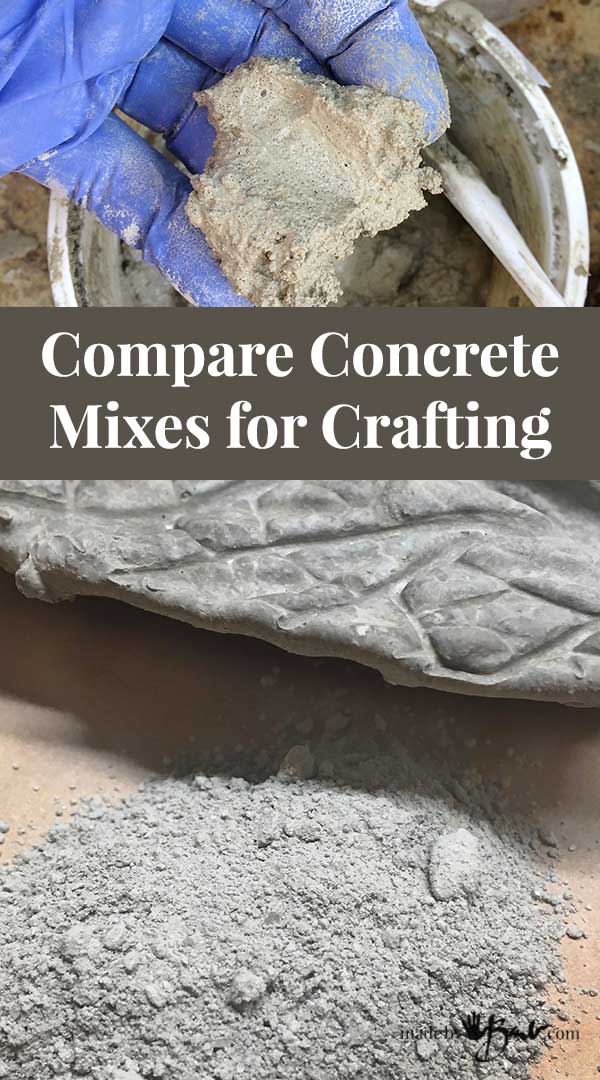
I know what it’s like standing at the concrete aisle and getting that odd look from the guys at the building supply store… Since I get a lot of questions about which concrete to use I’m going to eliminate some of the guesswork. Follow me as I Compare Concrete Mixes for Crafting
So many Concrete Mixes for Crafting:
When I started buying concrete many years ago, I’d be quite puzzled reading and checking the packages. Someone would often think I was sent by my husband to buy ‘normal’ concrete. After a few attempts of trying to explain what I wanted to do I would just buy what I felt was right since they usually thought I was a bit crazy… Even nowadays there are so many that it’s quite daunting.
Cement and Concrete is not the same:
Do be aware that concrete is usually a mixture of portland cement & other things like sand and aggregates. The ingredients like the gravel give the concrete mixture strength, make it into a rock-like substance once cured.
I did know what I did not want; large aggregate in my mix, which is what the regular Concrete mixes usually have. They are quite cheap and can work for large pours in molds (planters), sidewalk slabs or fence posts. I am usually making smaller projects that are going to be cast in molds or hand shaped for decorative home use.

‘Leaf-casting’ was perfect to make my Concrete crafting tests since I like to work quite thin. These leaves are made with my new favourite; Savoy Cabbage!

Working Fast:
Since time is always short around my place so I like to see my projects finish quickly and I am constantly improving or redesigning so I can’t wait weeks or even days!
I really do love the ‘fast set’ mixes but am not exactly sure about what makes them set & cure so quickly and also so much stronger. There are special additives in the concrete mix resulting in a dense and less porous finish. The sand in these mixes is so much more fine than regular sand as well. Fast set mixes have special chemicals that make curing quite quick. Each manufacturer usually has some version of fast-setting concrete mix. These mixes also come with quite a hike in price, but it’s worth it in my eyes!
All concrete mixes go through curing process that involves hydration. The water is needed in order for proper curing to happen, and ensure that strength is achieved. Traditional bricks are made by firing clay in a kiln, much different than concrete.

Rapidset Cementall:
The above Rapidset Cementall is probably my all-time favourite! The specs say that it can be used at different consistencies and it will cure much harder (up to 9000 psi compressive strength) than regular concrete. I am sure there are specific additives like polymers for strength and those also make it quite moldable at a thicker consistency. This mix does not contain large aggregates.
I learn by testing and it has worked well for many of my projects. Usually readers who have had concrete problems it’s because of their choice of concrete mix.
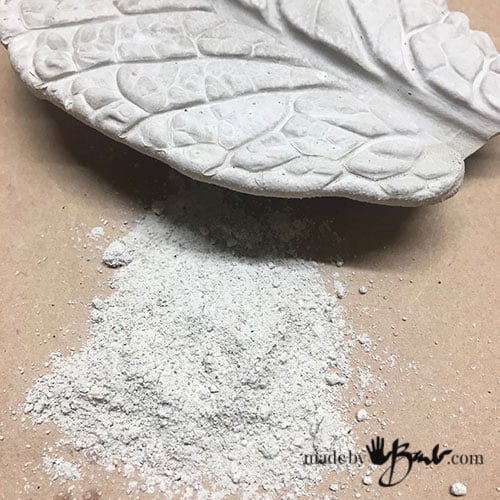
Rapidset Cementall Concrete Mix will start to thicken in about 30 seconds and can usually be taken out of the mold after 1 hour. The molds that I make are quite stiff and this mix will withstand the vigor needed to sometimes take them out. This mix is super fine, will pick up all the details and provide a super smooth white finish. A shiny finish can be achieved if the mold is also shiny material. It tends to not have many bubbles since the consistency can be fairly fine & does not need as much water as other mixes.
So Strong Concrete:
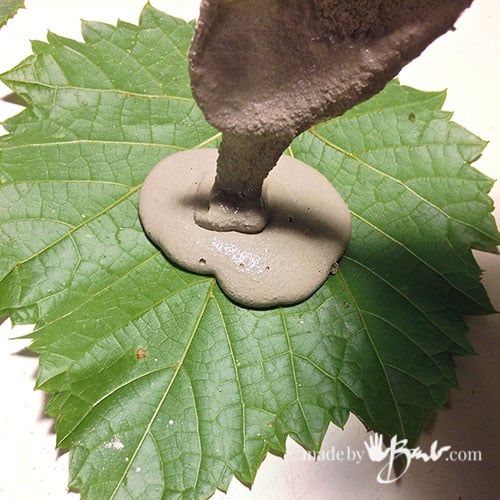
At a thin consistency it will be easily poured such as the Coasters and the Monster Eggs. The strength achieved in a thin wall is quite amazing! Check out all the projects that this mix is great for.
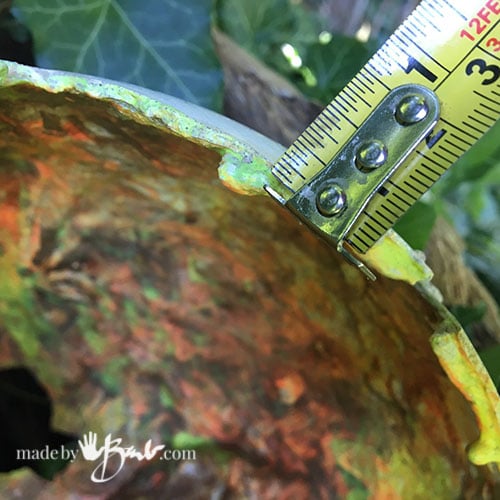
When reading the specs for different mixes it will give you a clue at how it can/should be used. ‘Featheredge’ means that it can be used at a very thin edge layer. Some mixes will state not to be used above a certain thickness.
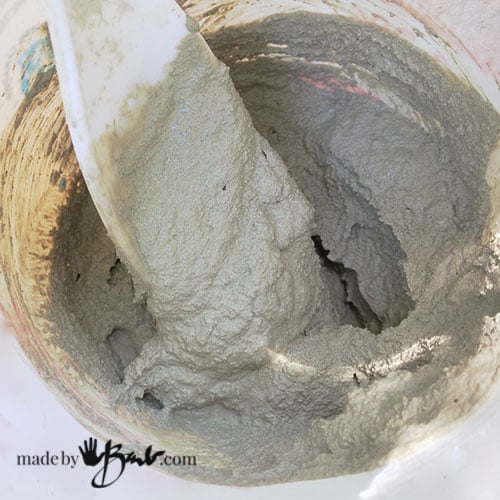
The Rapidset Cementall mix can also be used at a thick; sculptable consistency. It will still slump ( a high pile of mix will flatten and sag) but not usually run away. That makes it work well for leaf casting such as the Lacy Circle the Smiling Stones. The workflow can be quite fast since sections harden quickly allowing more material to be added such as around an Orb or a Face sculpture fairly quickly. Temperature will also accelerate the setting/curing.
Dampening the drier sections is good practice before adhering new mix so there is good adhesion..
Quikrete Fastset All-crete:
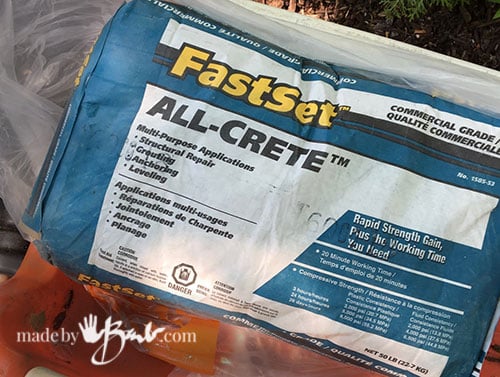
Different brands offer similar products. Since entering the Quikrete contest I wanted to use a Quikrete product that compared to the RapidSet Cementall. I find this mix is almost exactly like Rapidset Cementall. It does seem like it comes under a few different names; Dual Purpose Grout & Structural Repair, Fastset Repair Mortar and Quikrete Fastset All-Crete. (See a selector guide here) It may be a difference of countries (here in Canada) Do NOT confuse it with any regular Fastset Mix though, as it will have large aggregate in it. If it says that it is meant to make sidewalks, post foundations and foundation walls then it usually contains large aggregate.
When comparing different types of concrete mix read the fine print and specifications.
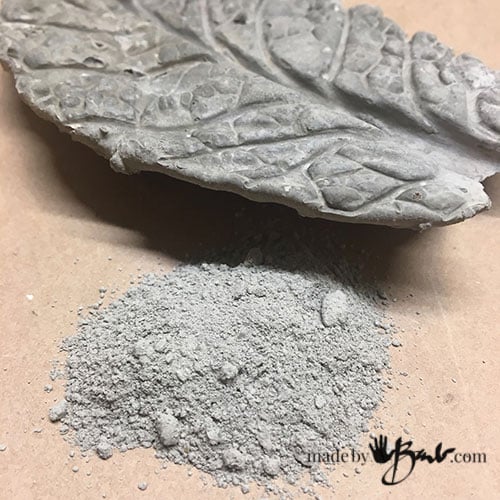
Quikrete Fastset AllCrete has much of the same qualities, workability and also stated it can be used at all kinds of consistencies. It also a fine powder but the colour is more like a true concrete ‘grey’; darker than Rapidset Cementall.
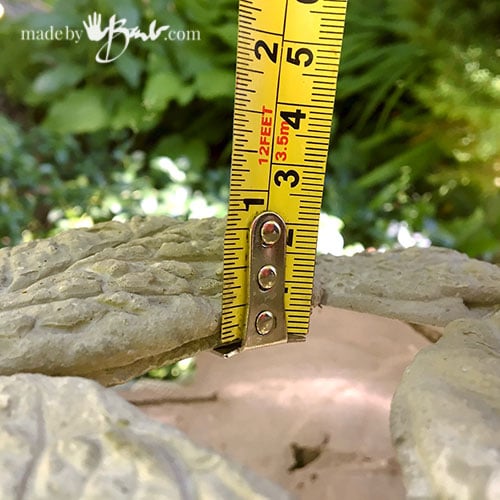
The DIY Gigantic concrete Leaf Orb used this mix. It performed well at less than 1/2″ thick and the quick-setting allowed great workflow.

Make sure to consider enough overlap as this will make the open-work structure strong.
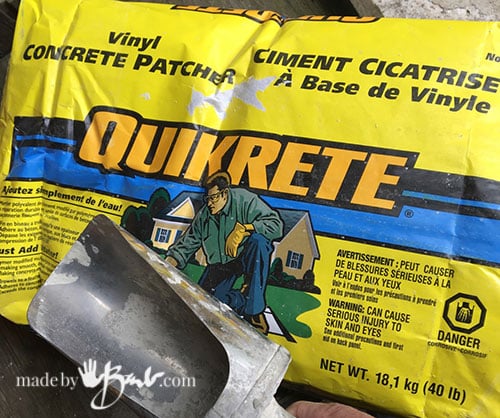
Quikrete Vinyl Concrete Patcher:
This product will also work well if you can wait a bit longer. Quikrete Vinyl Concrete Patcher also has additives to make it really strong but does not set as fast as the first 2. It has a window of 30 minutes of work time (conditions can affect it) and will be hard in 24 hours. It has good bonding abilities so layering works great as in this Giant Orb making.
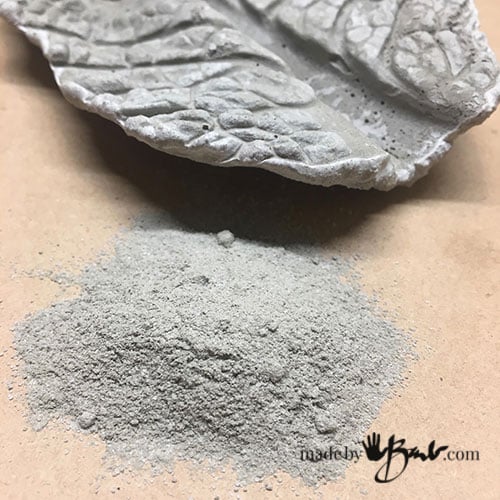
You can see it still is a fine mix but I’d say it feels a bit more sandy. It cures to a similar concrete colour to the Fastset. You can see a slight bit more texture in the final product.
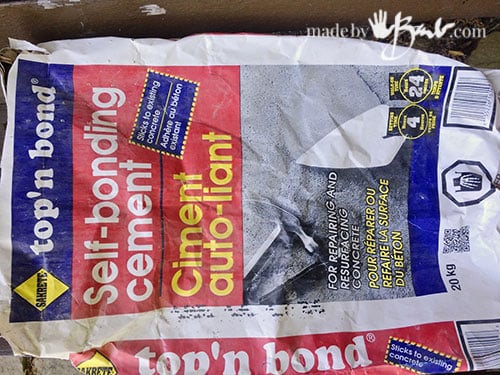
Sakrete Top’n Bond:
This is another of the bonding mixes with great strength and it performs very much like the Quikrete Vinyl Patch. Sakrete Top’n Bond will work for the continuous building around an orb shape (ball of some type) or casting of thin leaves. It will set & cure in about day as well.
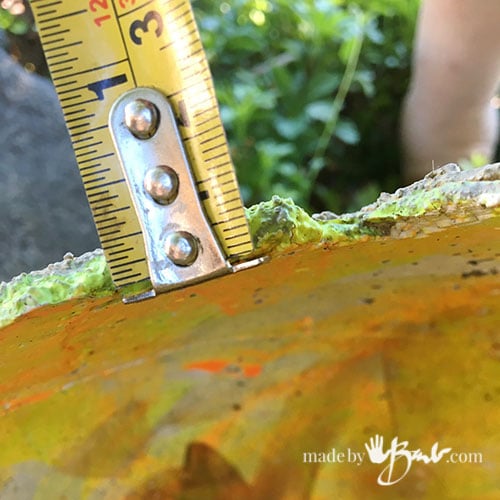
My 20″ Giant Orbs have lasted well through the canadian winters and are light enough to carry with one hand. Amazingly only 1/4″ thick. These are considered ornamental garden sculpture so if it was stepped on it would likely break.
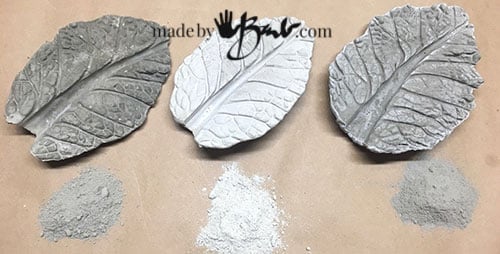
So, there you have 3 direct comparisons (left to right) Quikrete Fastset Allcrete, Rapidset Cementall, and Quikrete Vinyl Concrete Patcher. This is by no way the only available mixes but it does give me quite the selection. Also notice the difference in colours…
As for sealers; you will notice I often do not seal my orbs since I like the look of old patinated concrete. I am also happy to report I have not had any issues with cracking with these mixes. If you have issues about cracking see this post.
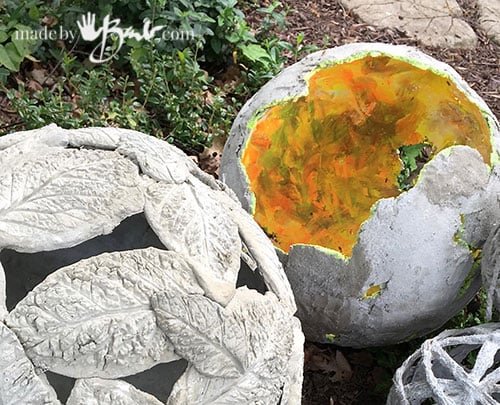
If you are still a bit apprehensive about working with concrete visit my tips post. Believe me; it does not mean that you need to be ‘covered in concrete’ to make some easy concrete crafting treasures! Concrete crafting is like making a cake mix that does not need baking… And you can almost keep it forever! Concrete crafting – made simple…
Hi barb, thank you so much for sharing this very useful information. I’ve been testing different materials for 1 month and I really needed this information. Although I do not know English very clearly, you are so glad you learned so much
Thanks!
Hi, Barb! I love your pins on Pinterest! I am retired and crafting away. I’m recently interested in sculpting; i.e., clay, cement, etc. I want to build/sculpt a figure using cement and want your opinion. I feel like Rapidset Cementall will be my best bet after reading your blog on all the different types of cement. Whew! There’s a lot to know when going into this. The figure will have some height (not more than 2 feet) and will be an outdoor decoration for a plant, or birdseed, etc. In building the ‘body’ of this figure, is it best to let it dry first and then build it up and up after each application of cement? Meaning, if thick enough, it won’t slush down? If necessary I can send a picture of what I’m trying to make in a separate email. Thank you! Virginia Dryden
Frankly the Rapidset Cementall sets so fast that I manage to keep working and adding as I have for the Gigantic Leaf orb. It will depend on how/if you need to maneuver the sculpture as you work on it. Sometimes it even sets too fast, before I can use what I have mixed. If you are subscribed you can reply to an email post.
Hi Barb,
I just love your artwork. Thank you for sharing with us. I have a question about sand. I’ve tried using an all purpose sand, but it was too rough and gritty. The hardware store suggested paver sand, which I purchased today. After opening the bag I found it to be kinda chunky too. I tried finding the Quikrete sand/topping mix locally, but had no luck. Do you have any other sand suggestions? Can I use play sand?
Well, the sand topping mix is much like regular concrete but does not have the large aggregate in it. I have read (but not tried) to sift out the large bits to be ending up with something like the sandtopping mix. I would think the portland cement and sand would make a good mix. I recall there being some recipes printed on the bag. The sandtopping mix is not a super one like the Rapidset Cementall but it finishes pretty smooth since the portland cement fills the voids between the grains of sand. When I am trying to figure out things I do a small test mix of just a little pour. It does also depend what you are making…
Hi iam from NZ i am wandering what tuoe of cement i would use to do a few simple DIY garden pots . This will be my first attempt.
If they are going to fairly thick walled then a Sand-topping mix should be fine. It would be like these? Use flexible plastic for ease of removing from the mold…
Hi Barb, thanks for your helpful information!!! I am planning to DIY concrete planters. Since I am going to paint some cute patterns on it, I am looking for a concrete mix that will have a smooth surface and not pricey (I am a student, and don’t have lots of budgets). which concrete mix will you recommend? Thanks so much!
If you are using some plastic containers as molds and keep the walls thick enough then you can use a cheaper ‘Sand-topping mix’. It’s pretty normal concrete without large aggregate in it. Some people sift out the large stones to use it as it’s pretty cheap. It will be a somewhat sandy texture when done, tamp well so no bubbles… Good luck
Thanks so much for your suggestion!!
Hi Barb,
I’m making an indirect mosaic for the first time and the depth of the finished project will be an inch deep and a foot long square. What kind of concrete mix would you recommend? I don’t want to be rushed as this is my first time, so maybe rapidset wouldn’t be the best idea. Would the quikrete vinyl patcher work–if so what was the proportion of cement to water that you used?
Many thanks,
Sam
I had a follow up question, too. I was thinking about using the quickrete sand/topping mix to cast a one inch thick indirect mosaic (it is a foot long and foot wide). I recall that you made stepping stones with the sand/topping mix–one question I have is that for applications between 1-2 inches where the sand-topping mix is being bonded to another substance (in my case the mosaic tiles), Quikcrete recommends using a bonding adhesive. Would this be necessary for my project? My gut tells me no–I think the bonding adhesive is only suggested for concrete to concrete, not for rough mosaic tiles, but I thought I’d ask.
Thanks again!
That’s a tough one. Many moons ago I had made mosaics on premade concrete patio stones using the proper tile adhesive and then a sanded grout (figured if it worked in the shower it would work outside) however the tiles/grout lifted in the canadian winters. It’s probably going to be horizontal so more chance of taking in any moisture. I’m afraid water may get between the tiles and concrete and then freeze/lift. I know the rapidset is super quick but maybe working small sections could work. It is so dense that I don’t see any water penetrate as other concrete.
If the tiles are porous you don’t want them stealing the moisture from the concrete either so they should be damp/wet. Bottles of the bonding agent are pretty cheap so I’d suggest considering the amount of work you’d be doing. Another option is once finished you give it a super good waterproofing/sealer and be diligent with freezing and water conditions. That’s the best advice I can give considering I’ve not done it. I have combined stone with the rapidset with bonding agent.
I don’t use measurements when mixing, I go by how much flow/slump I want. The vinyl patch may be a good choice but it does not really seem that ‘vinyl’ when done. My orbs have held up over winters well but they don’t have added inclusions…
As you know I think you are the bees knees. I want to know if you have ever used bonding liquid in your cement to make it more pliable for sculpting? If so what is the ratio to water/cement? Thanks
Bonding liquid seems like some version of acrylic medium. I had thought it’s mostly just for helping new concrete adhere to old. I wonder if it would really make a difference. I like the Rapidset Cementall since it thickens enough that I can sculpt it nicely. It does not however become like a clay. There is also the option of Papercrete like this fellow So many options….
Your site has been great for my inspiration and confidence to try new projects. My hypertufa mix now is 3 parts portland cement 1 part type s mortar mix, 4 parts spagham peat moss, 3 parts vermiculite and one part perlite. Its great for bird bathes and troughs. Thank you from California
As a teacher in post secondary school as well I find inspiring is the vital first step! Happy Making!
Thanks for all of the information and anecdotal comments. I tried to make some stepping stones this weekend. What a disaster. I too was one of those newbies standing in front of the bags of concrete at Home Depot, hoping someone would see my despair and confusion. Alas, the product I ultimately chose had stones in it bigger than big! I knew it wouldn’t work when I opened the bag at home, but I mixed it up and pored then into my cake tins, already line with mosaics on contact paper. And of course when it was dry, and I flipped them over, most of the mosaic just crumbled off. LOL – I told my myself ‘I told you so’! I want to make some more – still a bit confused after reading all these posts. What would you recommend as the best (not quick set) product to use – I’m in Canada as well!! Thanks so much!
If you are doing the standard easy rhubarb leaf stepping stones then the Quikrete Sand topping mix is great. NO rocks! It’s also important to not just let it dry but let it cure while being damp. If you were a bit early to umold then it would crumble as it needs to cure for at least a day. Concrete driveways need to be wetted down especially if it’s a hot day. Water actually makes concrete cure to a harder state.
Thank you so much for this wonderful insight on the different concrete mixes. You have helped me tremendously.
It’s funny how many people think they are all the same; but it’s like cooking, you can’t substitute ingredients and expect it to work. It’s the number one mistake…