
Tips & Tricks for Concrete Crafting

For many the idea of being creative with concrete brings visions of huge metal mixers, shovels and mess. Let me show you some of my Tips and Tricks for Concrete Crafting so you too can make concrete art, like baking a cake.

It’s no mystery that I have quite the love for working in concrete. My fascination with casting things from molds started as a little kid and led me to this. Before I knew it I had used a bunch of different Concrete mixes, made my own and created quite the slue of original projects. I learned from ‘hands-on’ experimentation to create my own easy system that makes it all mess free and simple.
“What is concrete?”
The term ‘concrete’ is for a material that is created from a mix of aggregates with a cement that is activated with water. Once it goes through it’s reaction, which usually involves some heat production it ends up almost as hard as stone. Lime-based Portland cement is commonly used and mixed with gravel (crushed stone) to make the typical mix used for your sidewalks. But as a crafter I often use a finer mix but there are still a few to choose from.
Question: “What concrete mix should I use?”
I get many questions about this. If you get the wrong mix, it will usually not work. Many of my projects are designed with the character of the mix. This post will also help explain the pre-made mixes.
Portland Cement
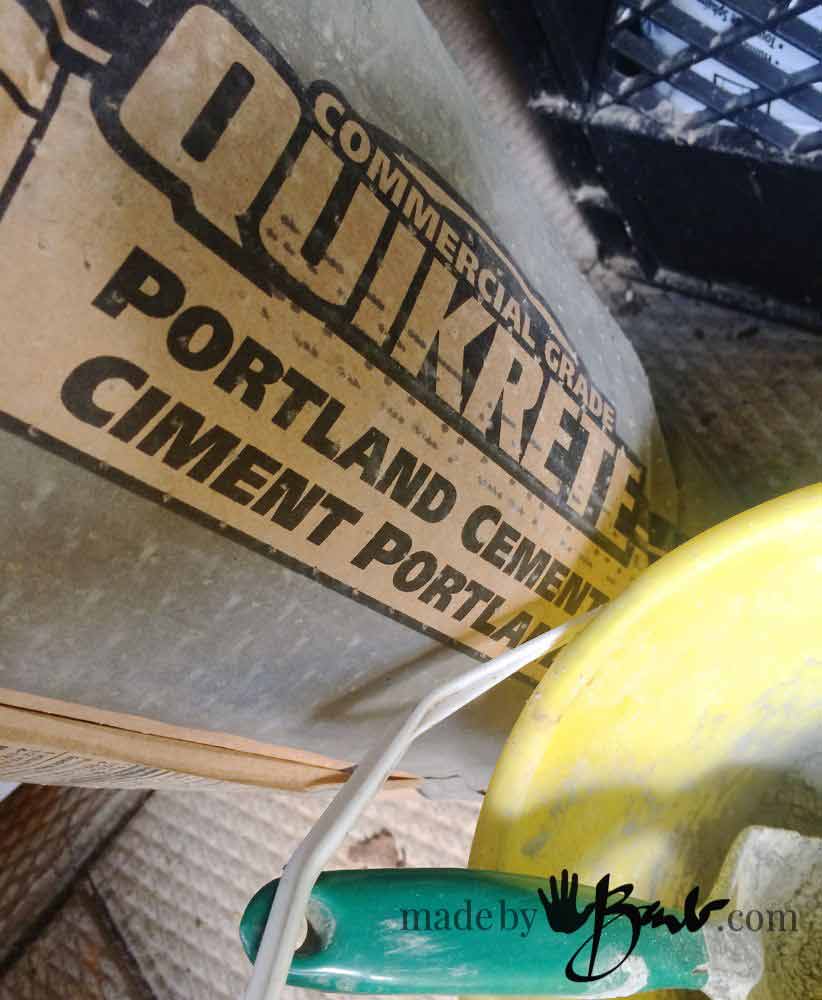
Portland Cement can be purchased as is so that you can make your own mix by adding other aggregates. It is also used when making ‘HyperTufa’. Depending what you mix into the portland cement will determine the final characteristics. It can range from just sand to perlite, peat, vermiculite, paper, styrofoam and probably more I’ve yet to discover.
If you want total control, this would be your choice as you are starting from ‘scratch’. I use this when making the CONCRETE ORBS using some dipping of yarn, and also the STEP SPOOK. In those cases the fabric fibres are the ‘aggregate’. Paper can be used as an additive and works quite well as in my PAPERCRETE BIRD

Sand Topping Mix
Sand Topping Mix is also one of my favourites. It is a simple mix of portland cement and sand. This inexpensive mix is meant to be used at less than 2″ thickness so it was perfect for the STEPPING STONES which were my first concrete adventure many years ago. They still grace my garden and are aging nicely. It has a fair strength when used at thicknesses over 3/8″ and worked well for the making of BOWLS and LIVE EDGE BOWLS and casting LEAF PLANTER. If you are new to concrete this is a good way to experiment. It can not be used at a very thin thickness.
Setting time is not accelerated and will need a good 24 hours before unmolding.

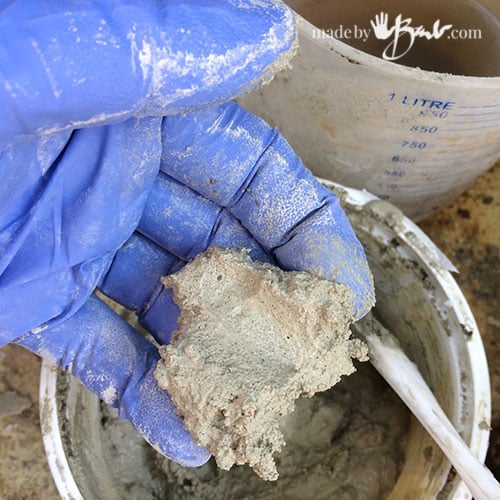
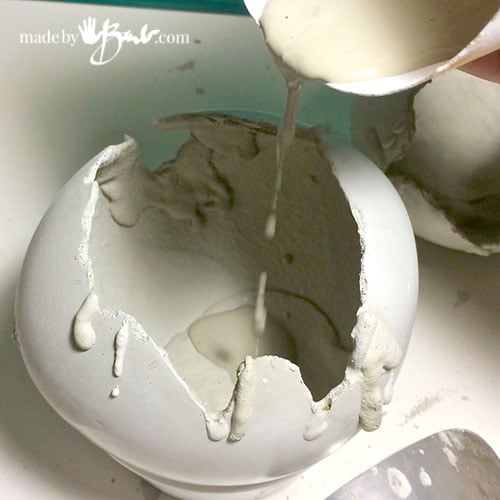
RapidSet Cementall
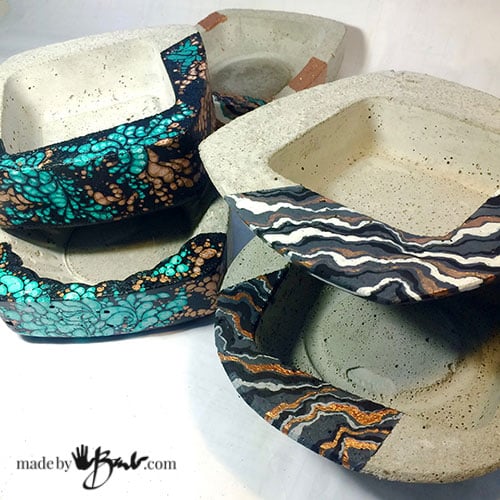
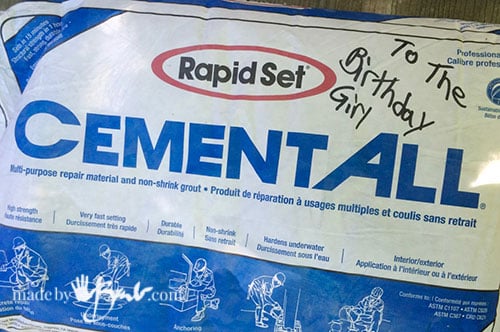
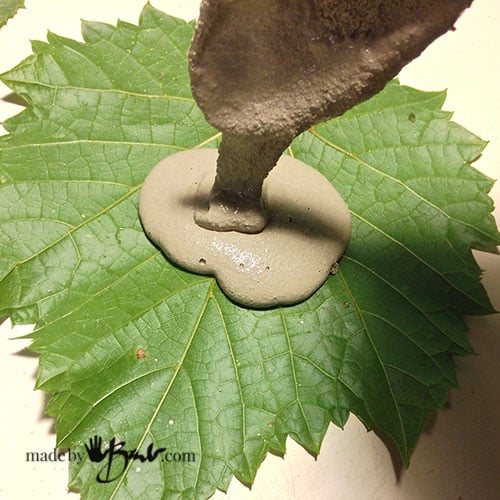
Rapidset Cementall is a brand name for a quickset concrete. This mix acts quite differently as it sets really quickly (5 minutes) and can be unmolded in 1 hour. I love this mix since I am impatient, but also because it is super strong! I experimented and have used it at 1/8″ thick with good strength (obviously not walking on) as it my LEAF COASTERS. This mix can be used at different consistencies such as pourable or thicker malleable concrete. This pourability has allowed the ‘slush pouring’ of the CUTE HEADS and the TIN CANS, and even the EGGS. Thicker use has allowed the sculpting of the LEAF CIRCLES and the hilarious SMILING STONES and LARGE FACE SCULPTURE. Even the GEODES and GEODE LAMP used this mix!
There is something about this mix that does make the end product much finer though, as there are many additives to set it quick and add that strength. If you like the more rough industrial look this concrete has less of that since the aggregates are very very (powdered sugar-like) fine. Those are decisions you have to make. It is also more expensive due to those ingredients.


If you would like to see side-by-side comparison of a few mixes visit my post about fast-set and extra strength mixes.

Top’n Bond
Sakrete Top’N Bond is a form of a patching concrete which makes it adhere to existing concrete. It is sometimes called vinyl patch as there are added polymers. It has a good strength at minimal thickness and also some has malleability. The final product does have the coarser texture since there is sand in the mix. It has a medium setting time so it worked well for the GIANT ORBS since they are worked in stages.
“What do I need to Work with concrete?”
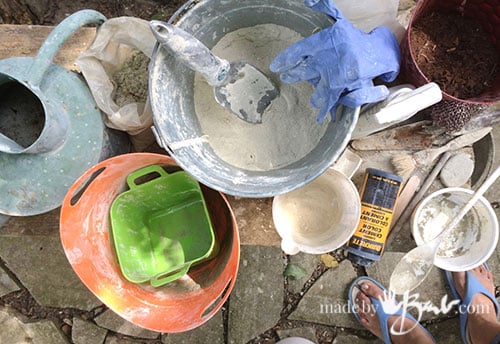
This is a what my collection of concrete ‘stuff’ looks like. It is really quite simple and I have quite the system now.
- Watering Can – is great as it just needs a bit of a tip to dispense, no fussing with a hose.
- Bucket of Concrete Mix and Scoop – keep this scoop dry and in the container to be able to add mix when needed.
- Plastic Mixing Containers – It is best if these are not too rigid (Yogurt containers work well). Wider containers are better for mixing than tall ones.
- Measuring Cup to dispense small amounts of water into the mixing container.
- Rubber or Nitrile Gloves – better quality makes them last longer.
- Dust Mask – rated for concrete silica dust I like my 3M8833 as it has an exhale valve.
- Spray Bottle with water – to mist when adding to existing dry concrete
- Mixing Spoons/Utensils – Plastic or wood
- Concrete Colour – if you would like a darker or tinted colour ( acrylic paints can work as well)
- Optional; Additives – if making a custom mix like Hypertufa or Papercrete; peat, sand, perlite, vermiculite, paper fibres, etc.
- Other Tools – like brushes, sticks, skewers, depending on project
“How To Work with Concrete and not make a big Mess?”

Step #1
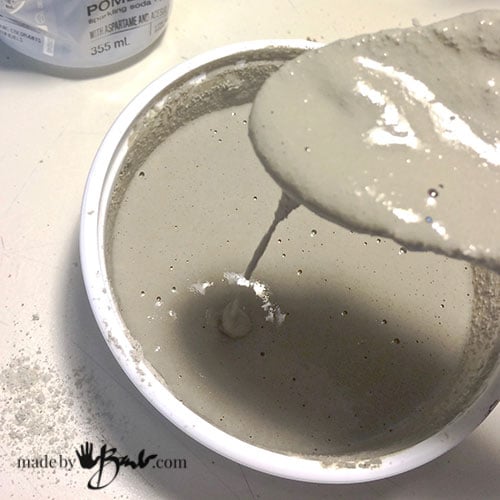
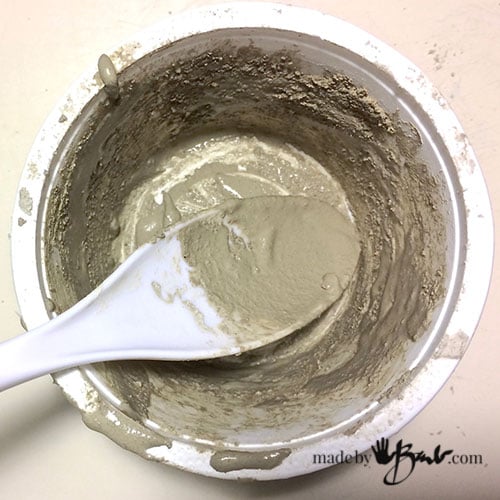
Use the scoop and place some ‘mix’ into the mixing vessel
Step #2
Use the measuring cup to add water slowly, mixing after each addition. The consistency that is needed will depend on the particular project and type of mix. The Rapidset Cementall works better if the water is added first. (each project tutorial also has details) Then follow the instructions to make your ‘great concrete project’.
Step #3
Do not wash anything, just let it set and dry. NEVER EVER wash it down the drain! It’s like NOT doing the dishes… We are not making a sidewalk here, usually just smaller craft objects.

Step #4
Once it is hard, just flex the container and the concrete will chip off. Bang it a bit and it will be clean enough for the next use. I like to use recyclable yogurt containers. Plastic buckets work well if you are working a bit larger scale.

Flex the spoon as well and it will become clean too.

Keep a bucket for all the cast off concrete. It can be used as aggregate later on or other planting uses. No mess or fuss!
“How do I make the concrete stronger?”
There may be times where you need a bit of assurance that your project won’t just crumble into pieces. In the big professional world they use steel rebar rods inside the concrete. We can use other methods of adding some reinforcement.
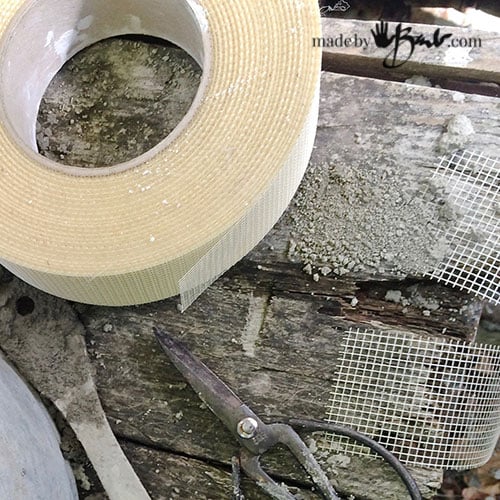
Drywall mesh acts as a reinforcement that can be cut and covered with concrete. If it is visible after curing it can be burnt away with a little torch.

You can also buy reinforcing fibres that are added to the mix. These work great as I have seen pieces that crack but hold together since there is the cross lacing of the fibres.
Anything that does not stretch can act as a reinforcement. Chicken wire, other metal mesh, yarn, wire, even fabric will add strength.
“How do I finish the rough edges?”
I admit, I hate sanding! I do not want to make a cloud of dust! So I design ways to keep that part to the minimum. That is why I like the rustic edges. There are times where you may have mixed a bit too much concrete, don’t throw it away! Make a ‘patty’ on some smooth surface (plastic is best) and let set.

This is now a great ‘sanding disc’, instead of using sandpaper or emery cloth. Also if you work with the pieces wet, there will be no dust and it will work well enough to take off the sharp corners.
I like to come up with projects where the rough edges are part of the design as in the LIVE EDGE CONCRETE BOWLS. That’s an artist’s trick; make any ‘mistake’ look intentional…
Simple Clean up:
Fill a very large bucket with water. If you need to get your hands or utensils clean use the bucket of water like a sink (I keep a rag nearby to dry). The particles will settle and you can use this for a while. When done, pour off the water and let the bottom sludge harden/dry to be knocked out.

So, there you have it! It isn’t as bad as you had imagined?! I hope I have taken away some of the fear of being covered in concrete. It is similar to working with plaster of paris but is much more durable. Go check out all the concrete projects I have and give it a shot! I know you can do it!
See this post before you go to the concrete store…
Wow. These are incredible! Great ideas. I have been in the concrete industry for a while, and you kind of just blew my mine. I will try some of these for sure. My wife with love them! Thank you!
I recently found your page as I was searching for the best type of concrete for fiber art and your page was presented.
Your work is beautiful and your instructions are perfect.
Thank you kindly.
Oh, that’s so nice to hear! I’m self taught and keep trying and dreaming up unique ideas! Stop by often!
Love your work. Thank you! Do you know if you can add resin to the cement mix to reinforce it and give it a sheen??
I am not completely sure but I would guess no. Resin can be picky about how it cures and concrete mixes have water in them. There are polymer additives to add strength and then a sealer can add the sheen. You could also use acrylic/latex paint. I would test a but first as some of the high strength mixes do not work well with additives.
Hi Barb
Love you’re work and appreciate you thoughts on a project I’m working on. My wife got me this really great concrete desk organizer from Owen and Fred (https://gearmoose.com/owen-fred-concrete-valet/) and I’m trying to reproduce it. I made a mold with Mold Star 30 but whenever I pour in the concrete, with and without hardener, the thin curb walls won’t dry even if I leave it in the mold for days. And suggestions would be greatly appreciated.
Thanks,
David
What mix have you tried? I bet Rapidset Cementall would work! I have made thin coasters with it. This post may help as well. Hope it works!
I am just starting playing with cement, what is the best kind for soaking old teddy bears in
I find just Portland Cement works for my draping so it should work for the teddies. I would try a small test… See also here
I’m retring in May and find the ciment project interesting your post looks very helpful 😉 Can we make a planter with ciment and leave it outside in the winter with the dirt in it , will it crack ???
There is a big chance it will. The reason is that anything that has moisture potentially will expand and therefore force the planter to crack. Concrete on it’s own does not break, that’s why I like orbs, they do not hold water or soil so they are fine. You can empty them and place a cover and they will be fine.
Would you happen to know the recipe for the watery cement you paint with. I’ve seen some sites where they shape styrofoam to resemble rocks and then they say they use Portland & water to paint over it and it really resembles rocks. But I’ve tried using just Portland & water on an object, and after it dries, it just rubs off and turns to sand again. Since you have such a vast knowledge of cement, I’m hoping you have touched on this technique in your travels. Any info you can share would be greatly appreciated.
Well, I have not done that directly as so but the draping I do with fabrics is just the portland cement and water. Maybe you let it ‘dry’ too quickly instead of curing under damp conditions. Water and portland cement will solidify but not be the strongest without other additives. I have some rock making ideas in my head and it’s just about getting warm enough (finally) here in Canada!!! I think you’d need some reinforcement and a stronger mix for the rocks.
Hi. I loved finding your sight, it is so helpful. Can you tell me when using the sand mixture in the yellow bag what the best mixture is ? Is it 2 to 1. How so you measure yours? I find it hard to get it right..
‘Happy you found it! I do not measure the Sandtopping mix, I mix it to a consistency that does not run away when put on the stepping stones. If I am making bowls then it can be a bit more fluid to fill the mold nicely. Suggested mix is 3.8 litres of water to 80lbs. That is about 47 millilitres per pound of mix. If you mix and stir, look at how much it slumps (flattens by itself) you can see if it is runny or will stay put. You will get the hang of it!
Thank you so much for the Rapid Set Cement All recommendation!! I am making garden edging, and Cement All works great!!
I love reading about all the things you make. I to love to create with concrete. At the moment I have a small problem which i hope you may be able to help me with. I have been making concrete pumpkins and yesterday I used tights instead of ordinary pantyhose. I cant get the tights off the structures. Have you any ideas?. I have tried sanding it off but all that does is make the concrete black in the area i sand.
Kind regards
Sue
I bet the problem is that it’s now imbedded in the concrete. How about a really stiff wire brush? It would break the fibres and maybe let them come off or get fuzzy. Maybe torching them off like I do the extra drywall mesh. If it if charred maybe a good scrub with some strong cleaner. Or just leave it and add a panted on layer of portland cement. I have seen those pumpkins and wondered if the hose actually would come off… 🤷🏻♀️
I was looking for a way to learn more about concrete crafting and I found this great guide. It is very helpful and gives you tips on how to make your own concrete projects. It is easy to understand because it provides clear instructions with pictures. This article will help you learn all the basic steps needed in order that you can create many different types of projects from small decorative items, such as vases, candle holders, or bottles, to larger ones like tables or benches.